

Codes and Compliance
Wildfire Vent Code, Testing, and Home Hardening Requirements
Wildfire vent requirements can vary by state, county, city, mapped hazard area, and project type. This guide explains the code language, test standards, and home-hardening concepts most often connected to fire and ember-resistant vents.
V2 Vents are designed for wildfire-prone construction, retrofit work, remodels, additions, and code-aware product selection where ember intrusion, heat, flame exposure, radiant heat, and ventilation performance all need to be considered.
Wildfire Doesn’t Care About Your State’s Building Code
Building codes vary by state, county, city, mapped hazard area, and project type. Wildfire exposure does not. Embers, heat, flames, and radiant energy can reach vulnerable vent openings whether a local jurisdiction has adopted modern WUI code or not. V2 Vents are built for wildfire-prone construction and retrofit work right here, right now, whether code has caught up or not.
California
CWUIC / Chapter 5 and Legacy Chapter 7A
California has one of the clearest wildfire construction frameworks in the country. The current California Wildland-Urban Interface Code, commonly referenced as CWUIC / Chapter 5, addresses exterior wildfire exposure and the protection of vulnerable building components, including vent openings.
Many builders, contractors, inspectors, and homeowners still use the older phrase “Chapter 7A” when talking about California wildfire construction requirements. On this page, Chapter 7A is treated as the legacy reference, while CWUIC / Chapter 5 is the current California code direction.
For vent openings, the compliance conversation often centers on approved wildfire flame and ember-resistant vents, WUI vents tested to ASTM E2886 / E2886M / 2912, and product approval through the California State Fire Marshal listing process.
Testing
What ASTM E2886 / E2886M / 2912 Means for Wildfire Vents
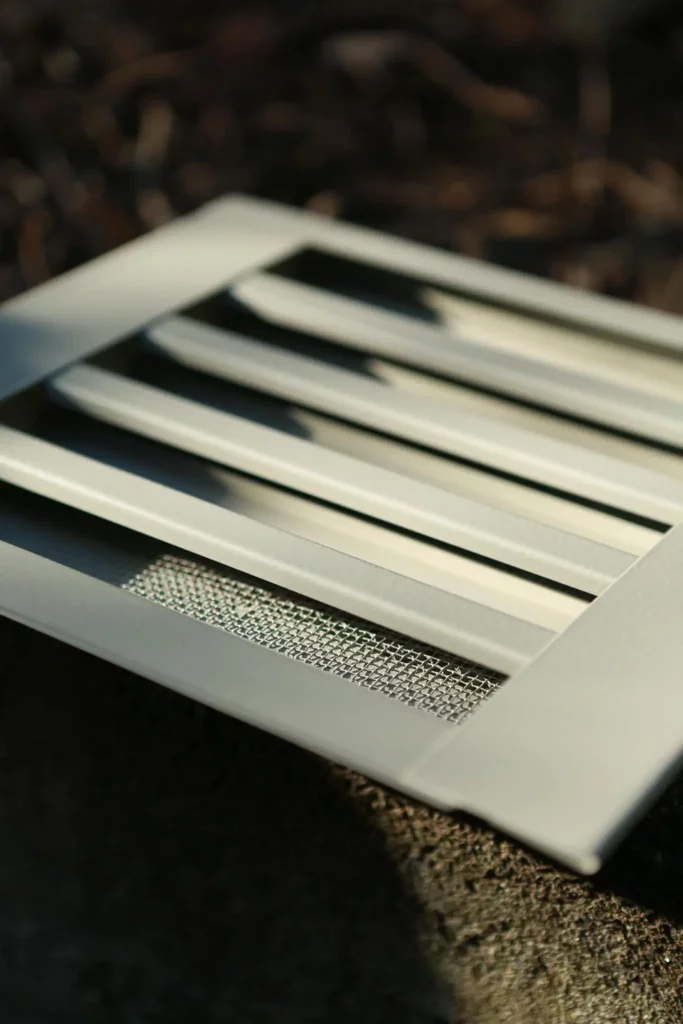
ASTM E2886 / E2886M / 2912 is a wildfire vent test standard used to evaluate whether exterior vents can resist ember intrusion, flame intrusion, and radiant heat exposure. It is one of the most important test standards connected to wildfire vent performance.
A listed wildfire vent is not the same as ordinary metal mesh. Mesh can help reduce ember entry, but a complete fire and ember-resistant vent assembly is designed and tested for a broader set of wildfire exposure conditions. This is especially true for vents tested in both horizontal and vertical directions. Fire doesn’t behave in one direction, neither should testing.
V2 Vents use a layered defense system that includes corrosion-resistant stainless steel ember mesh and a heat-activated intumescent honeycomb matrix. The mesh helps block wind-blown embers. The honeycomb matrix activates under wildfire heat to help block heat and flames at the vent opening.
WUI + Home Hardening
Code Compliance Is One Part of Wildfire Defense
WUI stands for Wildland-Urban Interface, the area where homes and other structures meet or mix with wildland vegetation. In these areas, wildfire risk is shaped by embers, radiant heat, direct flame contact, wind, slope, vegetation, building materials, and the condition of the structure itself.
Home hardening focuses on reducing the ways a structure can ignite during wildfire exposure. Vent openings are a major part of that work because they can allow embers, heat, flames, and fire gases to reach attics, crawlspaces, soffits, and other vulnerable areas.
V2 Vents are built for projects where code-aware product selection and practical wildfire defense are needed.
National Code Snapshot
Wildfire Vent Requirements Are Not Uniform Across the Country
Some states have mature wildfire building code frameworks. Others rely on local WUI ordinances, model-code adoption, home-hardening guidance, or voluntary mitigation programs. This table is a practical snapshot, not a substitute for local code review. Wildfire vent requirements vary by jurisdiction, mapped hazard area, project type, and local Authority Having Jurisdiction.
Always confirm final requirements with the local Authority Having Jurisdiction before selecting products for a specific project.
| State / Region | Wildfire Code Status | What It Means for Vents |
|---|---|---|
|
California |
Mature statewide WUI code framework through CWUIC / Chapter 5, with legacy Chapter 7A still widely referenced. |
California is the clearest state for approved, listed wildfire vents tested to ASTM E2886 / E2886M / 2912. |
|
Colorado |
Statewide wildfire resiliency code direction is developing, with local adoption shaping implementation. |
Listed wildfire vents and prescriptive mesh paths are becoming part of Colorado’s code-aware wildfire construction conversation. |
|
Texas / Austin |
Texas does not have one uniform statewide WUI vent rule, but Austin is a major local WUI code example. |
Austin shows how local jurisdictions can address vent openings as part of ignition-resistant construction. |
|
Oregon |
Oregon R327 wildfire hazard mitigation standards are locally adopted in several jurisdictions. |
Oregon guidance recognizes flame- and ember-resistant vents as part of home hardening, especially around exterior openings. |
|
Washington |
Washington is in transition, with local WUI requirements and statewide code movement. |
Local WUI language may address crawlspace and attic vents, mesh, and approved designs that resist flame or ember entry. |
|
Idaho |
Idaho wildfire code activity is largely local, with WUI overlays and local ordinances in fire-prone communities. |
Local IWUIC-style requirements may address vent size, mesh, and approved vent designs. |
|
Utah |
Utah has state and local WUI code history, with several jurisdictions using WUI requirements or local amendments. |
Vent language may include corrosion-resistant mesh or designs approved to resist flame and ember penetration. |
|
Missouri |
Missouri does not currently have a strong statewide wildfire vent code path. |
Local IWUIC adoption may create vent requirements in specific jurisdictions, but statewide vent mandates are not the main story. |
|
Florida |
Wildfire risk exists, but statewide code attention is more commonly focused on wind, flood, hurricane, and coastal resilience. |
This is a state where wildfire risk may be ahead of vent-specific code adoption. |
|
New York |
Wildfire and WUI risk exist, but there is no clear statewide wildfire vent framework comparable to California. |
Vent-specific wildfire construction requirements may depend on local hazard planning and AHJ review. |
This is the national reality: wildfire risk is spreading faster than wildfire building code adoption. Where modern WUI codes exist, they help create clearer product standards. Where they do not, property owners, builders, and specifiers still have to make real decisions about ember intrusion, heat, flame exposure, and vulnerable vent openings.
States Without Wildfire Codes
When Code Hasn’t Caught Up, Risk Still Exists
Some states are still deciding how aggressively to address wildfires through building codes. Others leave the decision to local jurisdictions, fire districts, mapped hazard areas, or individual property owners.
That does not make the wildfire exposure pathway any less real. Wind-blown embers can still enter attic vents, soffit vents, eave vents, crawlspace vents, roof vents, and wall vents. Heat and flame exposure can still reach the building envelope. Homes can still ignite through small openings that were never designed for wildfire conditions.
V2 Vents are built for people who do not want to wait for code adoption before addressing a known wildfire vulnerability.
Common Wildfire Code Terms
WUI — Wildland-Urban Interface
The area where structures meet or mix with wildland vegetation. WUI requirements may apply based on local mapping, hazard severity, project type, or local code adoption.
CWUIC / Chapter 5
California’s current Wildland-Urban Interface Code framework. It replaces older references that many people still call Chapter 7A.
Chapter 7A
The legacy California wildfire construction reference still commonly used by builders, contractors, architects, and homeowners.
ASTM E2886 / E2886M / 2912
A wildfire vent test standard used to evaluate ember intrusion, flame intrusion, and radiant heat exposure through exterior vent openings.
AHJ — Authority Having Jurisdiction
The local building department, fire marshal, or code authority responsible for interpreting and enforcing code requirements for a specific project.
IBHS Wildfire Prepared Home
A voluntary home-hardening designation program that includes wildfire mitigation requirements across the home and surrounding property. A vent product may support the pathway, but no single product creates whole-home designation by itself.
Built for Code-Aware Wildfire Projects
V2 Vents are designed for projects where wildfire defense, tested performance, airflow, and code-aware product selection all matter. They are built to help block embers, heat, and flames at vulnerable ventilation openings while supporting the high net free ventilation area needed for practical residential construction.
For homeowners, builders, architects, and specifiers, the goal is not just to meet the minimum requirement. The goal is to choose products that address the real wildfire exposure at the vent opening.
Have a Project in a Wildfire-Prone Area?
Codes change. Local requirements vary. Wildfire risk is already here. If you are planning new construction, retrofit work, a remodel, an addition, or a home-hardening project, V2 Vents can help you address one of the most vulnerable openings on the structure.
