

Colorado’s wildfire risk continues to rise as development expands into fire-prone landscapes and fire behavior becomes more intense and unpredictable. In response, the state has adopted the Colorado Wildfire Resiliency Code (CWRC), placing a new emphasis on how building components perform under ember exposure, especially ventilation openings.
For builders, architects, and inspectors, understanding how vents must comply under Section 403.4 is now a critical part of wildfire-resilient design. This guide explains how the code addresses wildfire-resistant vents, why ventilation openings are a priority, and how to select appropriate solutions based on jurisdictional requirements and performance expectations.
What Is the Colorado Wildfire Resiliency Code?
The Colorado Wildfire Resiliency Code was developed to reduce structure loss caused by ember-driven ignition, now widely recognized as the leading cause of home destruction during wildfires. Rather than focusing only on direct flame exposure, the code addresses how embers penetrate building envelopes and ignite structures internally.
Much of the CWRC aligns with wildfire construction principles established in California and the International Wildland–Urban Interface Code (IWUIC), adapting those standards to Colorado’s building landscape. Like those codes, the CWRC emphasizes limiting ember entry, reducing surface ignition, and slowing fire spread between structures.
Because vents are common failure points during ember storms, their protection is treated as a core element of wildfire mitigation, not an optional upgrade. This reflects a broader shift in wildfire science toward focusing on building openings and transitions rather than only exterior finishes.
Why Ventilation Openings Are a Major Wildfire Vulnerability
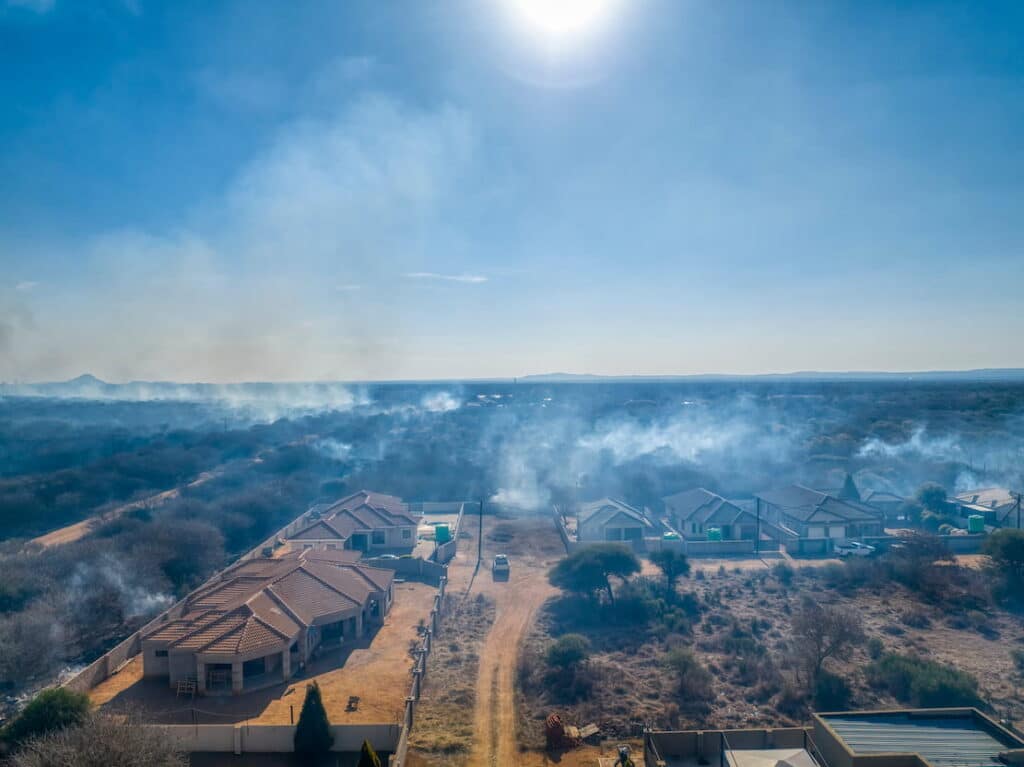
Vents are essential for moisture control, indoor air quality, and long-term building durability. At the same time, they provide direct access to concealed spaces such as attics, wall cavities, and crawlspaces; areas where embers can ignite materials without visible exterior flames.
During wildfire events, changing wind pressure and turbulent airflow can force embers into vent openings. Once inside, embers may ignite insulation, framing members, or accumulated debris, allowing fire to spread internally before exterior damage is visible.
Post-fire investigations consistently identify vents as common ignition pathways, even in homes built with fire-resistant siding and roofing. This is why modern wildfire codes now treat vent protection as essential to home hardening, rather than relying solely on exterior wall and roof material ratings.
Ventilation Requirements Under Section 403.4
Section 403.4 of the Colorado Wildfire Resiliency Code establishes two approved paths for vent compliance:
- Performance-based compliance (Section 403.4.1)
- Prescriptive compliance (Section 403.4.2)
Both paths are code-compliant when allowed by the local authority having jurisdiction. However, they represent different approaches to managing ember intrusion and flame exposure, and which option is permitted depends on how each jurisdiction adopts and enforces the code.
Understanding the distinction between these paths helps builders select vent solutions that satisfy inspection requirements while aligning with project risk profiles.
Performance-Based Compliance (Section 403.4.1)
Under the performance-based path, vents must be tested and listed to demonstrate resistance to ember intrusion and flame penetration under standardized conditions. The primary test referenced is ASTM E2886, which evaluates vent assemblies during ember exposure, flame contact, and airflow pressure.
Vents that pass ASTM E2886 testing are typically listed by accredited certification agencies and approved for use in higher-risk wildfire zones where stricter performance requirements apply. This compliance path is often required in jurisdictions with elevated hazard classifications or where local amendments adopt more restrictive wildfire mitigation standards.
Performance-based vents are designed to:
- Block ember entry under wind-driven conditions
- Limit flame intrusion during short-duration exposure
- Maintain ventilation while managing airflow pathways
This path is typically required when building officials mandate listed wildfire vent assemblies as part of exterior fire-hardening systems.
Prescriptive Compliance (Section 403.4.2)
The prescriptive compliance path allows builders to protect vent openings with noncombustible, corrosion-resistant mesh installed over them. The code specifies maximum mesh opening dimensions, typically no more than 1/8 inch.
This option reflects earlier wildfire construction guidance that recognized ember-size thresholds as a means of reducing ember entry. When properly installed and maintained, mesh can reduce ember intrusion and remains an acceptable compliance method in jurisdictions that permit this alternative.
However, prescriptive mesh does not provide flame resistance and is not tested as a complete vent assembly under ember and flame exposure conditions. Its performance depends on:
- Installation quality
- Material durability
- Ongoing maintenance to prevent clogging or damage
For these reasons, prescriptive mesh is generally considered a baseline ember-screening method rather than a full wildfire vent system.
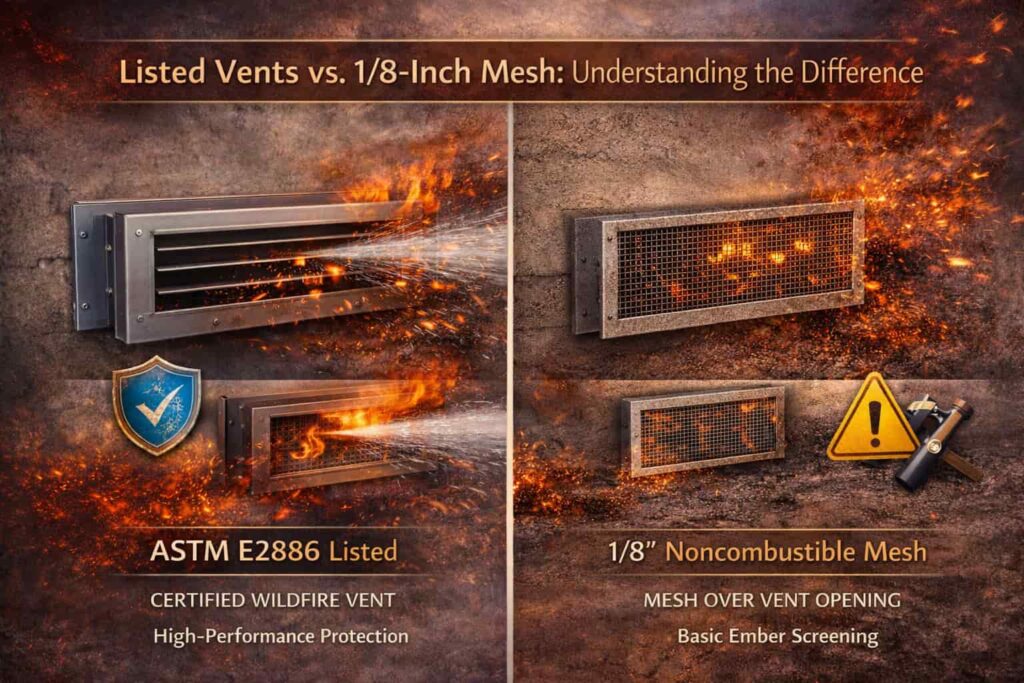
Listed Vents vs. 1/8-Inch Mesh: Understanding the Difference
While both compliance paths may satisfy code in different jurisdictions, they do not provide the same level of protection or performance verification.
Listed wildfire vents tested to ASTM E2886 are evaluated as complete assemblies under simulated wildfire conditions, including ember exposure, flame contact, and airflow pressure. Their performance is documented through standardized testing and third-party certification.
Prescriptive mesh, by contrast, is evaluated primarily by material type and opening size. It is not subjected to system-level testing for flame intrusion or sustained ember exposure. While mesh can reduce ember entry, it does not manage airflow dynamics or flame contact in the same way as listed vent assemblies do.
From a risk management perspective, listed vents provide greater confidence under severe wildfire exposure, while prescriptive mesh offers basic ember screening where code allows flexibility. Both approaches have a place in code-compliant construction, but they represent different performance expectations.
Choosing the Right Wildfire Vent for Colorado Projects
Selecting appropriate wildfire vent solutions in Colorado requires understanding both code allowances and local enforcement practices.
In jurisdictions that require ASTM E2886-listed vents, product selection is straightforward; listed assemblies must be used to meet inspection requirements.
In jurisdictions that allow prescriptive mesh, builders may choose between installing mesh-based protection or exceeding minimum standards with listed vents. Some projects elect to exceed baseline requirements to improve resilience, address insurance concerns, or prepare for future code updates.
When evaluating vent strategies, design teams should consider:
- Local adoption and amendment of the CWRC
- Wildfire hazard severity classifications
- Insurance underwriting expectations
- Long-term maintenance requirements
Where prescriptive compliance is permitted, selecting higher-performance mesh systems can improve ember screening while remaining within allowable code frameworks.
How Local Interpretation and Inspections Affect Vent Selection
Even when statewide codes are adopted, local jurisdictions retain authority over how compliance is interpreted and enforced. Some building departments issue additional guidance on acceptable vent types, documentation requirements, or installation methods, particularly in designated high-hazard areas or post-fire rebuild zones.
In practice, this means two projects in different Colorado counties may face different inspection expectations, even when both reference the same state code language. Inspectors may request manufacturer listings, third-party test reports, or installation details to confirm that vent assemblies meet the applicable compliance path.
For builders, confirming expectations early with the authority having jurisdiction (AHJ) can prevent costly revisions or failed inspections later in the project timeline. For designers, clearly documenting vent performance criteria in construction drawings helps align subcontractors and reduces ambiguity during plan review.
Understanding how code language translates into field enforcement supports smoother approvals and more predictable construction outcomes, especially as wildfire regulations continue to evolve across the state.
Wildfire-Resistant Construction Is a System, Not a Single Product
Vent protection is only one part of wildfire-resilient construction. Exterior assemblies must work together to reduce ignition risk. Fire-resistant siding, noncombustible soffits, protected rooflines, and controlled ventilation openings all influence how a structure performs during ember exposure.
Industry guidance on wildfire-resistant siding systems consistently emphasizes that wall materials alone cannot prevent ignition if embers enter through adjacent openings and transitions. Embers bypass fire-resistant finishes and ignite concealed spaces when vents, soffits, or rooflines are not equally protected.
System-based design recognizes that no single product can provide complete wildfire protection. Instead, consistent performance across all exterior assemblies reduces the likelihood that small vulnerabilities escalate into full structural ignition.
For builders and architects, this means coordinating vent selection, siding materials, roof detailing, and debris management strategies early in the design process, rather than treating wildfire mitigation as a collection of separate upgrades.
Final Considerations for Builders, Architects, and Designers
Code compliance establishes minimum construction standards, but wildfire resilience depends on how well materials perform together under real-world conditions. As wildfire behavior evolves and insurance requirements continue to change, building professionals are increasingly expected to consider performance beyond minimum thresholds.
Thoughtful material selection, consistent detailing, and coordination across trades support smoother inspections and reduce future retrofit needs. In wildfire-prone regions, these design decisions also help limit structure-to-structure fire spread and support broader community safety goals.
Understanding both performance-based and prescriptive compliance paths allows design teams to meet regulatory requirements while selecting solutions that align with project risk profiles and long-term durability expectations.
The Colorado Wildfire Resiliency Code reflects growing recognition that ember intrusion is a primary driver of home ignition during wildfires. Section 403.4 places ventilation openings at the center of the mitigation strategy, offering both performance-based and prescriptive compliance paths depending on jurisdictional requirements.
While both paths can satisfy code under specific conditions, they offer different levels of protection and performance certainty. Selecting wildfire-resistant vents should be based on local enforcement requirements, hazard severity, and overall exterior system design—not on vent selection in isolation.
By approaching wildfire-resistant construction as a coordinated system, builders and designers can significantly reduce ignition risk and improve long-term resilience in Colorado’s wildfire-prone communities.
To better understand vent requirements and system-based mitigation strategies for your project, review local code amendments, consult product documentation, or contact a wildfire mitigation specialist for guidance on jurisdiction-specific compliance.

