

Material classifications and individual code requirements frequently evaluate fire-resistant construction. However, wildfire exposure does not occur in isolated components; it happens across interconnected exterior assemblies subjected to wind-driven embers, radiant heat, and pressure differentials.
When exterior materials are not designed to perform together, small discontinuities at vents, soffits, and roof transitions can undermine otherwise fire-resistant wall and roof systems. This is why ignition often occurs through concealed spaces, even in structures built with noncombustible exterior finishes.
This article emphasizes how fire-resistant construction materials must operate as a coordinated system, highlighting why consistent ember protection across all exterior assemblies is vital for wildfire resilience.
Why fire resistant Construction Must Be System-Based
Wildfires threaten structures through a combination of wind-driven embers, radiant heat, and direct flame contact. While fire-resistant siding and roofing help reduce flame spread, they do not address the most common ignition mechanism in modern wildfires: ember intrusion.
Ignition typically occurs when embers lodge in combustible materials or penetrate building envelopes through vents, joints, or small gaps. Once inside, embers can ignite insulation, framing, or accumulated debris, allowing fire to start from within the structure, often without visible exterior flames.
Because ignition pathways are interconnected, treating the exterior as a unified system is essential. To help builders and inspectors, include guidance on evaluating and selecting compatible components, such as vents, siding, and flashing, that work together to prevent ember intrusion and fire spread. These methods ensure that performance isn’t compromised by incompatible or overlooked details, increasing confidence in fire resistant design.
The Role of Exterior Assemblies in Wildfire Zones
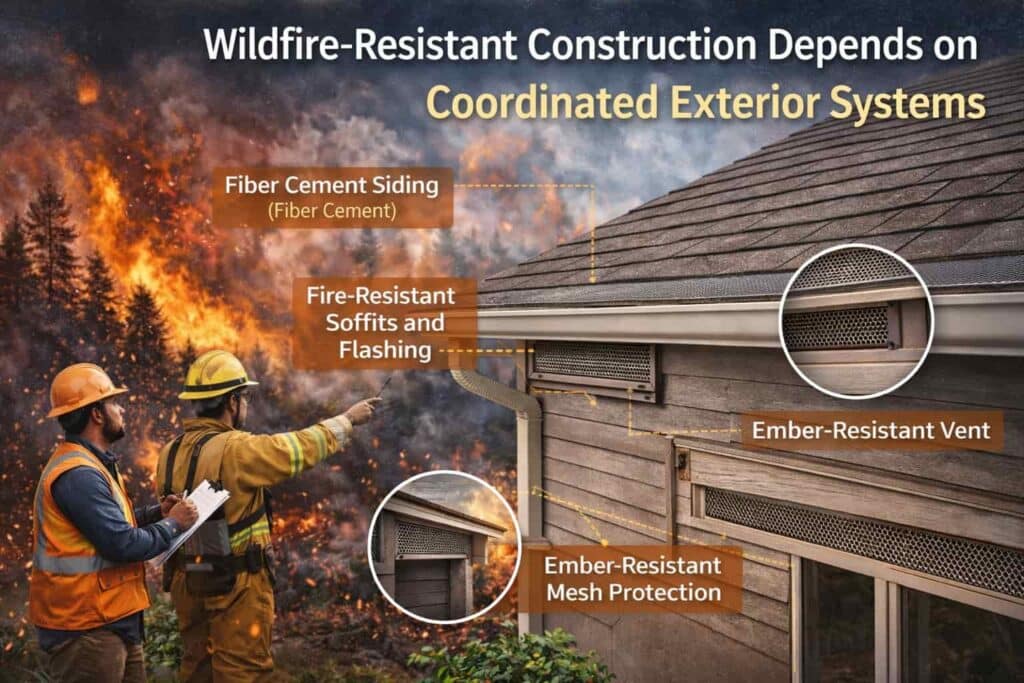
Exterior assemblies—including walls, roof systems, soffits, and penetrations—form the primary barrier between a structure and wildfire exposure. Failures rarely occur in the middle of uninterrupted wall surfaces. Instead, ignition typically begins at transitions and interfaces, such as roof-to-wall intersections, soffit edges, ventilation openings, foundation vents, crawlspaces, and deck-to-wall safety, highlighting areas where inspectors can focus their attention.
These transition zones are where airflow, combustible debris, and ember accumulation intersect. During ember storms, changes in wind pressure can actively draw embers into these locations, bypassing otherwise fire-resistant exterior surfaces.
From a construction and inspection standpoint, these areas are also where materials from different trades intersect. Roofing, siding, framing, and ventilation systems are often installed by separate crews, increasing the likelihood that performance assumptions may not align across assemblies. Small detailing choices, such as vent placement, trim profiles, flashing integration, and sealant compatibility, can significantly influence whether embers are deflected or allowed to accumulate.
Building inspectors and fire officials increasingly evaluate how well components integrate, not just whether individual products meet listed requirements. This shift reflects growing recognition that wildfire performance depends on continuity of protection, not simply on product ratings.
Rooflines and Debris Accumulation as Ignition Catalysts
Roof geometry plays a critical role in how embers behave during wildfire exposure. Valleys, dormers, roof-to-wall intersections, and gutter systems tend to collect leaves, needles, and other combustible debris over time. During ember storms, these areas act as natural traps where hot embers can lodge, smolder, and ignite surrounding materials.
Even when roofing assemblies meet Class A fire-resistance ratings, ignition risk can still develop if embers ignite debris near vulnerable construction details. Flames may then spread to fascia boards, soffit edges, and vent openings, creating multiple potential entry points into concealed spaces.
From a systems-design perspective, rooflines should be evaluated not only for material classification but also for how they manage debris, airflow, and ember exposure. This is why wildfire mitigation guidance increasingly emphasizes reducing debris accumulation at roof transitions, protecting roofline ventilation openings, and integrating gutter protection into exterior fire-hardening strategies.
When rooflines are treated as part of the overall exterior fire-defense system, rather than as isolated components, the structure’s ability to resist ember-driven ignition improves significantly.
Fire-Resistant Siding and Exterior Wall Systems
Fire-resistant siding materials, such as fiber cement, stucco, and certain metal cladding systems, play an important role in reducing flame spread and limiting radiant heat exposure to wall assemblies. These materials can slow ignition and protect framing from direct flame contact, improving survivability when exposed to advancing fire fronts.
However, siding alone does not address ember-driven ignition, which is responsible for a significant portion of structure losses during wildfire events. Embers rarely ignite large vertical wall surfaces directly. Instead, they accumulate at window and door trim, vent penetrations, soffit interfaces, and horizontal ledges or decorative features.
Without proper protection of components like vents and soffits, even the best siding can be compromised. This reinforces the importance of pairing fire-resistant wall systems with equally robust protection at all openings and transitions.
Ventilation Openings as a Key Wildfire Vulnerability
Fire investigators and research organizations consistently identify ventilation openings as high-risk ignition pathways. Attic, soffit, and crawlspace vents are necessary for moisture control and building durability, but they also provide direct access to concealed spaces during ember exposure.
During wind-driven fire conditions, embers can be forced into vents through pressure differentials and turbulent airflow. Once inside, embers can ignite attic insulation, roof framing, stored materials, and wall cavities. This internal ignition often occurs without visible exterior flames, delaying detection and suppression.
As a result, vents are frequently cited as the point where otherwise fire-resistant structures fail. For this reason, fire resistant construction standards increasingly require that vents meet ember-resistance criteria, empowering fire officials and inspectors to enforce critical safety measures.
Ember Protection as a Supporting Exterior System
Ember protection components are designed to address the specific hazard of airborne debris entering vulnerable openings. These systems typically include ember-resistant vents, fire-resistant mesh used to screen existing openings, and protective coverings for soffits, decks, and crawlspaces.
Effective ember protection requires balancing two competing priorities: blocking ember intrusion while preserving adequate ventilation. If airflow is overly restricted, moisture accumulation and thermal buildup can create long-term durability problems. If openings are too large, ember intrusion risk remains unacceptably high.
For this reason, modern ember-resistant assemblies rely on engineered mesh densities, material thickness, and vent geometries that manage airflow while preventing ember penetration under wind pressure. This design approach differs significantly from traditional insect screening or coarse metal mesh, which may slow debris but cannot reliably stop wind-driven embers.
From a system standpoint, ember protection components should be selected and installed to complement adjacent materials. When protection levels are inconsistent, embers will exploit the weakest link in the assembly.
Aligning Exterior Materials for Consistent Fire Performance
One of the most common weaknesses in fire resistant construction occurs when high-performance materials are paired with minimally protected openings. Examples include fire-resistant siding installed alongside unprotected vents, Class A roofing systems with debris-prone rooflines, or noncombustible walls paired with combustible soffit materials.
These mismatches create uneven performance, in which isolated vulnerabilities determine the overall ignition risk. From a design standpoint, this undermines the intent of fire-resistant construction because the system fails at its weakest component.
Coordinated exterior design requires evaluating how materials perform together under ember exposure, radiant heat, and wind conditions, not simply verifying that individual components meet isolated code requirements.
Designing for Compliance and Long-Term Wildfire Resilience
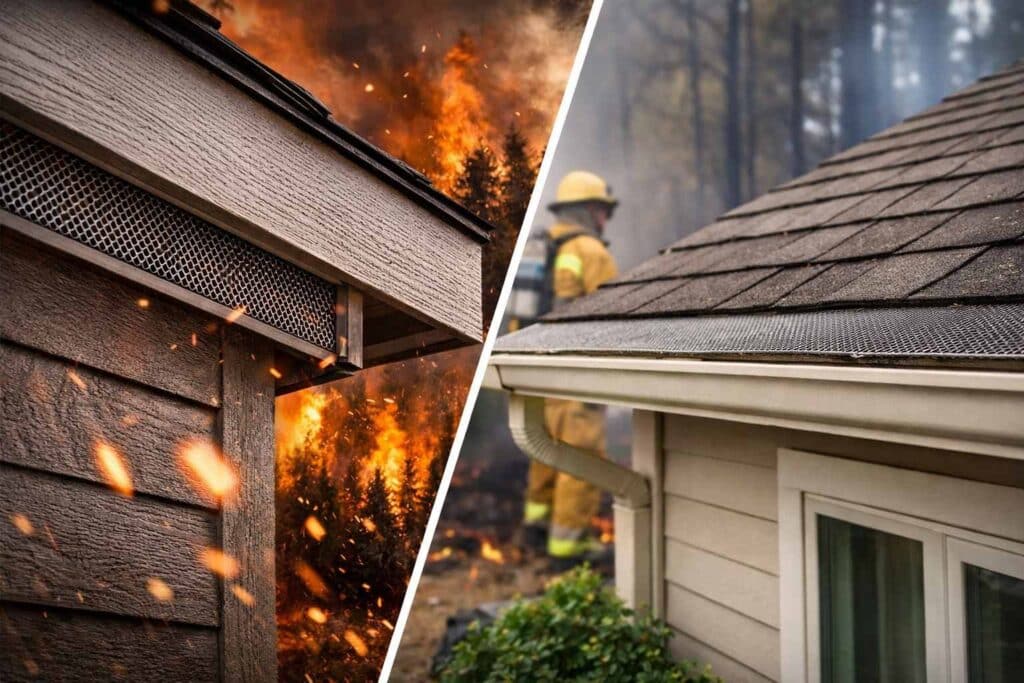
Wildland–Urban Interface (WUI) codes establish minimum construction requirements intended to reduce wildfire ignition risk. However, compliance does not necessarily represent optimal performance, especially as wildfire behavior continues to evolve.
While codes establish baseline protection thresholds, wildfire exposure does not operate within regulatory categories. Embers do not differentiate between materials that narrowly meet requirements and those that exceed them. In practice, structures exposed to prolonged ember storms may face conditions beyond what minimum standards anticipate.
This is why performance-based design is becoming more relevant in wildfire construction. Builders and designers are increasingly considering future insurance underwriting standards, evolving building codes, and client expectations for long-term resilience when selecting exterior systems.
System-based design also supports smoother inspections, fewer retrofit needs, and better long-term performance outcomes.
Fire resistant construction depends on how well exterior materials work together to reduce ignition risk. While fire-resistant siding and roofing play important roles, they cannot perform effectively without corresponding protection at vents, soffits, rooflines, and other openings where embers most often enter.
A systems-based approach recognizes that exterior assemblies function as a continuous envelope and that failure at any single point can compromise the entire structure. By aligning siding, ventilation, and ember protection components, builders and designers can significantly reduce vulnerability to ember-driven ignition.
For professionals working in wildfire-prone regions, early coordination of exterior materials and detailing remains one of the most effective strategies to improve long-term building resilience and support safer communities.
Learn more about ember-resistant vent systems and exterior protection strategies, or explore broader home hardening resources to support your next wildfire-resilient design.

