

As Colorado continues to expand development into wildfire-prone landscapes, ventilation requirements have emerged as one of the most scrutinized components of the state’s Wildfire Resiliency Code. Once treated as a secondary detail, vents are now recognized as a critical line of defense against ember intrusion, which research consistently identifies as the leading cause of structure ignition during wildfires.
For builders, architects, and inspectors, vent compliance is no longer a box to check late in the construction process. It is a design decision that directly influences ember exposure, inspection approval, and long-term building performance. Complicating this decision is the fact that Colorado’s code allows more than one path to compliance. Depending on jurisdiction, projects may be permitted to use either performance-based listed wildfire vents or prescriptive 1/8-inch noncombustible mesh, even though these options differ substantially in testing, durability, and real-world behavior under wildfire conditions.
Understanding how these two compliance paths work, where each is allowed, and the level of protection they actually provide is essential for making informed, code-aligned decisions that support both regulatory approval and meaningful wildfire resilience.
Overview of Wildfire Vent Requirements in Colorado
The Colorado Wildfire Resiliency Code identifies ventilation openings as one of the most vulnerable points in a structure during a wildfire. While vents are essential for moisture control, airflow, and long-term durability, they also create direct pathways into attics, wall cavities, and crawl spaces. These concealed areas are particularly dangerous during wildfire events because embers can ignite materials without any visible exterior flame contact.
During ember storms, wind pressure and turbulent airflow can actively force embers into vent openings. Once inside, embers may ignite insulation, framing members, or accumulated debris, allowing a fire to start internally and spread before occupants or firefighters are aware of the threat. This mechanism explains why post-fire investigations repeatedly identify vents as common points of failure, even in homes constructed with fire-resistant siding and roofing.
Colorado’s approach closely mirrors principles found in California wildfire standards and the International Wildland–Urban Interface Code (IWUIC), while allowing local jurisdictions flexibility in how those standards are enforced. The state code establishes approved compliance paths, but their application depends on local amendments, wildfire hazard severity classifications, and enforcement priorities set by Authorities Having Jurisdiction (AHJs).
Understanding the Two Compliance Paths
The Colorado Wildfire Resiliency Code permits two distinct approaches to vent compliance. Both are code-approved when allowed by the AHJ, but they are not equivalent in performance, testing methodology, or long-term resilience.
The two compliance paths are:
- Performance-based compliance using listed wildfire vents
- Prescriptive compliance using 1/8” noncombustible mesh
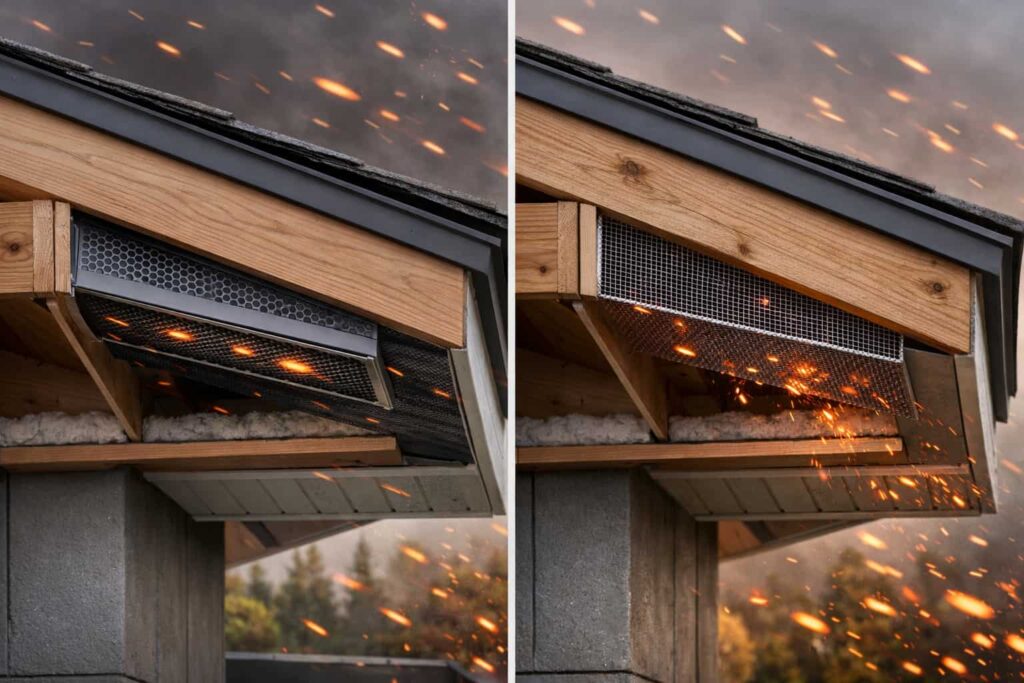
At a high level, the difference between these paths reflects two regulatory philosophies. Performance-based compliance evaluates how a vent assembly behaves under simulated wildfire conditions, while prescriptive compliance evaluates whether specific materials and dimensions are present. Understanding this distinction is critical because it directly affects real-world performance during ember exposure and how confidently a system performs beyond minimum code thresholds.
Performance-Based Compliance: Listed Vents (ASTM E2886)
Performance-based compliance relies on vents that have been tested and listed to demonstrate resistance to ember intrusion and, in some cases, limited flame exposure. The most widely referenced standard for this testing is ASTM E2886, which evaluates vent assemblies under conditions designed to replicate wildfire exposure.
ASTM E2886 testing examines how a vent performs under wind-driven embers, short-duration flame contact, and airflow pressures similar to those experienced during wildfire events. Importantly, this testing evaluates the vent as a complete assembly rather than as individual components. Vents that pass are listed by accredited certification bodies, providing documented, third-party verification of performance.
Listed wildfire vents are commonly required or strongly preferred in:
- Higher wildfire hazard severity zones
- Jurisdictions that adopt stricter wildfire mitigation amendments
- Projects seeking to exceed minimum code requirements or reduce long-term risk
Because listed vents are evaluated under standardized conditions, their performance is predictable and verifiable. Documentation simplifies plan review and inspection, reducing ambiguity for inspectors and minimizing the likelihood of disputes in the field. For many design teams, this clarity makes performance-based compliance an attractive option where wildfire exposure is a significant concern.
Prescriptive Compliance: 1/8” Noncombustible Mesh
The prescriptive compliance path allows vent openings to be protected using noncombustible, corrosion-resistant mesh with openings not exceeding 1/8 inch. This approach reflects earlier wildfire construction guidance that focused on limiting ember size to reduce entry.
When permitted by local jurisdiction, mesh is installed over vent openings to act as a physical barrier against embers. If properly installed and maintained, prescriptive mesh can provide a baseline level of ember screening and remains code-compliant in areas where this alternative is allowed.
However, prescriptive mesh is not evaluated as a complete assembly under wildfire conditions. It is not subjected to flame-exposure testing, nor does it account for airflow-driven ember transport in the same way that performance-based testing does. Effectiveness depends heavily on installation quality, material durability, and ongoing maintenance. Over time, deformation, clogging, corrosion, or improper attachment can reduce performance, particularly during high-wind wildfire events.
Prescriptive compliance is often permitted in lower-risk areas or where jurisdictions have chosen to allow flexibility for cost or constructability reasons. While it meets minimum code requirements, it provides less certainty in severe wildfire conditions.
Listed Vents vs 1/8” Mesh: Key Performance Differences
Although both compliance paths may satisfy code requirements depending on jurisdiction, they offer different levels of protection and performance certainty.
Listed wildfire vents tested to ASTM E2886 are evaluated as complete systems under ember exposure, airflow pressure, and flame contact. Their behavior under stress is documented, repeatable, and verified through standardized testing protocols. This provides high confidence that the vent will perform as intended under wildfire conditions.
Prescriptive mesh, by contrast, is evaluated primarily by aperture size and material type. It does not undergo flame testing and offers limited resistance to sustained ember exposure or turbulent airflow. While mesh can reduce ember entry, it does not control airflow pathways or internal pressure effects as effectively as listed assemblies do.
From a real-world wildfire perspective, listed vents provide greater reliability during severe events. Prescriptive mesh provides a minimum level of screening that may be appropriate in lower-risk applications where code allows, but it does not deliver the same level of performance consistency.
When Listed Vents Are Required Under Colorado Code
Some Colorado jurisdictions require or strongly encourage the use of listed wildfire vents, particularly in areas with elevated wildfire hazard classifications. These requirements are often driven by a combination of wildfire history, local risk assessments, and lessons learned from past structure losses.
When listed vents are mandated, early coordination with the AHJ is critical. Confirming requirements during the design phase helps avoid plan review delays, inspection failures, or costly retrofits later in the project. In jurisdictions with stricter enforcement, inspectors may expect clear documentation demonstrating that vents meet ASTM E2886 or equivalent performance standards.
Because enforcement varies across the state, builders and designers should verify vent requirements early and in writing. This proactive approach reduces uncertainty and supports smoother project delivery.
When Mesh Is Allowed and Why Builders May Choose to Upgrade
In jurisdictions that permit prescriptive compliance, 1/8-inch mesh may satisfy minimum code requirements. This option is often selected for projects focused on baseline compliance or where wildfire hazard severity is lower.
However, many builders choose to exceed minimum standards even when mesh is allowed. Common reasons include improved ember resistance, reduced long-term liability, evolving insurance expectations, and future-proofing against code changes. As wildfire behavior intensifies and regulatory frameworks evolve, solutions that exceed minimum requirements can provide added confidence and durability.
Where prescriptive compliance is permitted, selecting higher-performance mesh systems can improve ember screening while remaining within an accessible compliance framework. These decisions reflect a growing emphasis on resilience rather than minimum compliance alone.
Wildfire Vent Selection as Part of a Larger Defense System
Vent protection does not function in isolation. Vents interact with siding, soffits, rooflines, and other exterior assemblies to form a continuous building envelope. If one component underperforms, it can undermine otherwise fire-resistant materials.
Ember intrusion often occurs at transitions and penetrations rather than flat wall surfaces. System-based wildfire resilience requires consistent protection across all exterior components, not isolated upgrades.
Coordinating vent selection with siding materials, soffit construction, roof detailing, and ember protection strategies strengthens overall performance and reduces ignition risk.
Final Considerations for Builders, Designers, and Inspectors
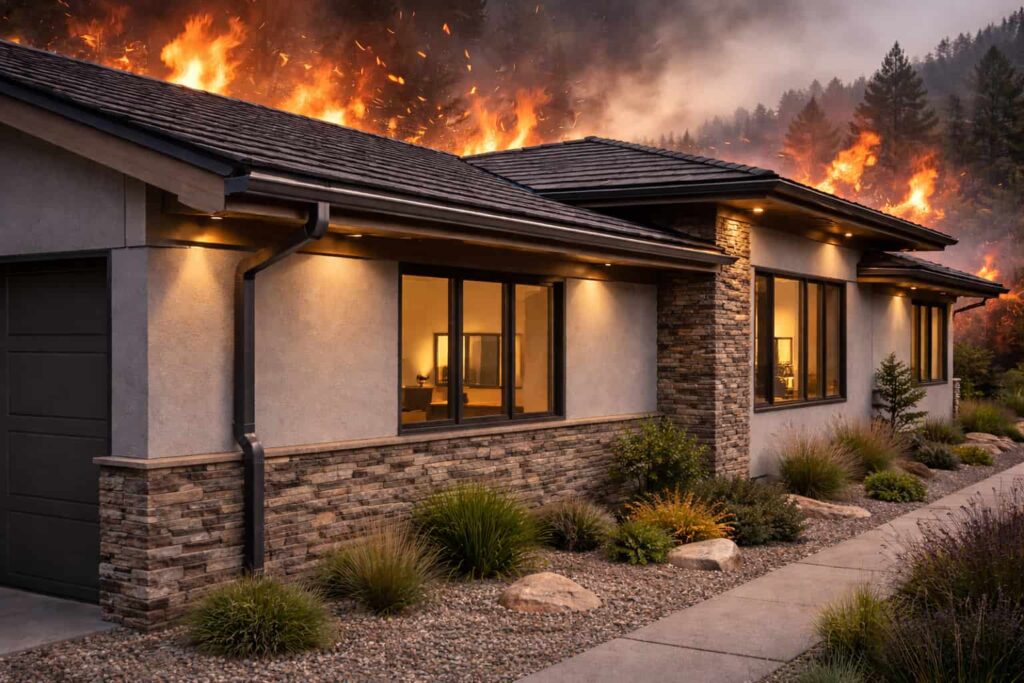
Ember intrusion most often occurs at transitions and penetrations rather than across uninterrupted wall surfaces. Wind pressure, roof geometry, soffit design, and debris accumulation patterns all influence how embers move around and into a structure. A vent that performs well in isolation may underperform if adjacent components are not designed with ember exposure in mind.
System-based wildfire resilience requires consistent protection across all exterior assemblies. Coordinating vent selection with siding materials, soffit construction, roof detailing, and maintenance strategies significantly reduces ignition risk and improves overall performance.
Final Considerations for Builders, Designers, and Inspectors
Understanding wildfire vent requirements means looking beyond whether a product technically meets code. Jurisdictional requirements, documented performance, long-term durability, and compatibility with the broader exterior system all influence wildfire outcomes.
By understanding both compliance paths, project teams can reduce inspection challenges, improve resilience, and make informed decisions aligned with site-specific wildfire risk. Early coordination, clear documentation, and system-based design remain among the most effective strategies for reducing ember-driven ignition.
The Colorado Wildfire Resiliency Code reflects a growing recognition that ember intrusion is a primary driver of structure ignition during wildfires. Ventilation requirements under the code provide two compliance paths—performance-based listed wildfire vents and prescriptive 1/8-inch mesh—each offering different levels of protection and performance certainty.
While both approaches may meet code depending on jurisdiction, they are not equivalent in real-world wildfire behavior. Selecting an appropriate vent strategy requires understanding local enforcement, hazard severity, and how vents integrate into the broader exterior system.
By approaching wildfire vent selection as part of a coordinated, system-based mitigation strategy, builders and designers can significantly reduce ignition risk and improve long-term resilience across Colorado’s wildfire-prone communities.
For clarification on vent documentation, jurisdictional interpretation, or system-based wildfire mitigation strategies, review local code amendments and consult qualified wildfire protection specialists. Firestorm’s technical team is available to help navigate compliance questions and support informed decision-making.
Contact Firestorm. We are here to help!

