

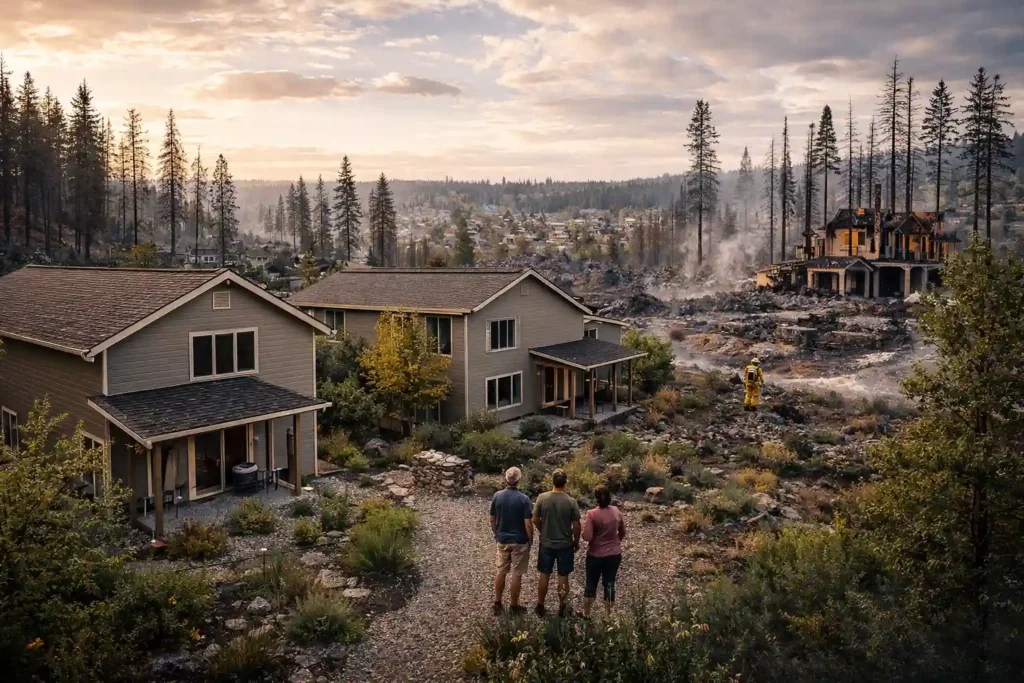
The destructive Los Angeles wildfires of 2025 left entire neighborhoods reduced to ash. News footage often shows towering flames and dramatic fire fronts, creating the impression that homes were simply overwhelmed by unstoppable fire.
The reality is more complicated.
In many cases, homes were not destroyed by a single advancing wall of flame. Instead, they were ignited by thousands of wind-driven embers—tiny burning fragments carried miles ahead of the fire. These embers landed on roofs, slipped through vents, and collected in gutters, igniting debris surrounding or inside homes. What investigators repeatedly discovered was not random destruction, but a pattern of predictable failures.
Understanding those failures is the foundation of effective home wildfire protection.
Our guide on how to protect your home from wildfire highlights recent wildfire research revealing why some homes survived while others didn’t, and focuses on practical DIY steps like clearing gutters and installing ember resistant vents to empower homeowners to reduce risk.
Wildfire survival, for both people and homes, is rarely about luck. It’s about preparation, system design, and eliminating vulnerabilities exploited by flying embers.
Watch: Why Homes Burn During Wildfires
This PBS Terra Weathered Analysis breaks down one of the most important truths about wildfire damage: embers are responsible for most home ignitions.
As you watch, pay attention to how wind-driven embers travel ahead of the fire, how homes ignite from small maintenance failures, and why certain structures survived while neighboring homes burned. The lessons highlighted in the video form the basis for modern wildfire home hardening strategies.
The Science of Survival: Why Some Homes Burned and Others Withstood
Wildfires spread through several mechanisms: flames can directly ignite structures, radiant heat can cause materials to combust, and wind-driven embers can ignite vulnerable points in a building.
Among these, embers are often the most destructive threat to homes.
During major wildfire events, burning vegetation and structures produce millions of embers that are lifted by powerful updrafts and carried by wind currents. These embers can travel more than a mile ahead of the fire, landing on rooftops, decks, or landscaping.
When they land on vulnerable surfaces, they create ignition points.
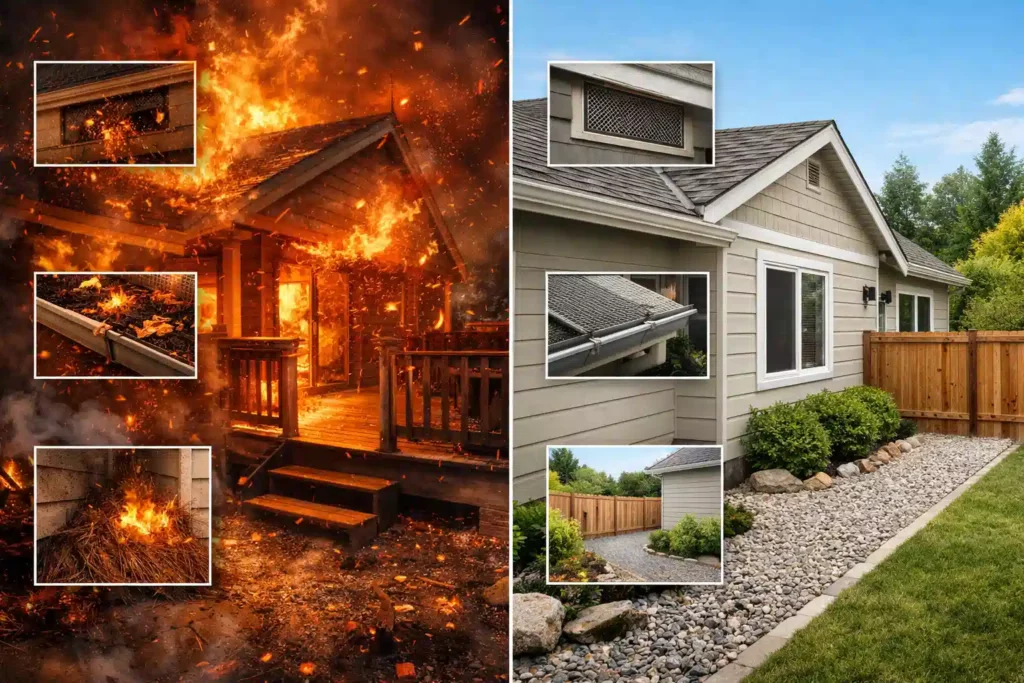
This process is known as ember intrusion. It occurs when embers enter small openings or accumulate in combustible materials around the home. Common ignition pathways include:
- Vent openings
- Gutters filled with debris
- Wood decks and fences
- Leaf accumulation against siding
- Landscaping close to the structure
In many wildfire investigations, homes that burned shared the same vulnerabilities. Recognizing these predictable, preventable ignition points can empower homeowners to take targeted action.
Meanwhile, homes that survived typically had fewer of these weaknesses. They had cleaner rooflines, hardened vent systems, defensible space around the structure, and fewer combustible materials near exterior walls.
This demonstrates how well a home prevents ember ignition and contributes to community resilience, encouraging homeowners to act for collective safety and shared peace of mind.
What an Ember Storm Actually Looks Like
When people imagine wildfire damage, they often picture flames reaching a house. In reality, many homes ignite long before the main fire front even arrives.
During major wildfire events, strong winds lift burning fragments of vegetation, structures, and trees into the air. These fragments break apart into thousands—sometimes millions—of small embers. Once airborne, they can travel significant distances ahead of the fire.
Researchers have documented embers landing more than a mile away from the active fire perimeter.
In these conditions, homes are exposed not to one single ignition source but to a sustained shower of embers. Rooflines, decks, landscaping, and vents may be struck repeatedly over the course of several hours.
This is why modern wildfire mitigation focuses so heavily on preventing ember intrusion. Even when flames never reach a property, ember storms can ignite vulnerable structures if combustible materials or open entry points are present.
Homes that resist ember ignition during this stage often survive even when surrounding areas burn.
Understanding the Wildland–Urban Interface (WUI) Reality
Across the western United States, more homes are being built in areas where communities meet natural vegetation. This zone is known as the Wildland–Urban Interface (WUI).
Living in the WUI offers beautiful landscapes and proximity to nature, but it also introduces wildfire exposure as part of everyday risk.
As these communities grow, fire response resources face increasing pressure. During major wildfire events, firefighters must prioritize life safety and strategic containment. This means emergency crews cannot defend every individual home.
For homeowners, this fact requires a shift in thinking.
Wildfire resilience is not solely the responsibility of emergency services. It begins with property-level preparation. This shift from reactive response to proactive mitigation is at the heart of modern WUI home protection.
When homes are designed and maintained to resist ember ignition, they are far more likely to survive even when firefighters cannot immediately intervene, as many investigations show, hardened homes often remain standing in neighborhoods where surrounding structures are lost.
The 5-Foot Critical Zone: Mastering Zone 0 Wildfire Protection
One of the most important concepts in wildfire mitigation is Zone 0 wildfire protection. Zone 0 refers to the first five feet surrounding a home’s exterior. This narrow band is considered the most critical area for preventing ember ignition because embers frequently accumulate near foundations, siding, and entry points.
If combustible materials are present in this area, even one small ember can ignite a structure.
Common risks within Zone 0 include:
- Wood mulch
- Dried leaves and pine needles
- Wooden fencing connected directly to the house
- Firewood stacked against exterior walls
- Flammable plants or shrubs
Replacing combustible materials with noncombustible surfaces dramatically reduces ignition potential.
Effective Zone 0 strategies include:
- Installing gravel, pavers, or stone landscaping
- Clearing leaves and debris regularly
- Removing wood mulch adjacent to siding
- Creating separation between wooden fences and structures
- Keeping decks and entryways free of debris
Many of these improvements can be completed in a weekend and are some of the most impactful steps a homeowner can take for DIY wildfire retrofits. By eliminating ignition sources within the first five feet of the home, homeowners remove one of the most common pathways for ember-driven fires.
Stopping Ember Entry: Your Home’s Armor System
While landscaping and debris management are essential, another major vulnerability lies in a home’s ventilation system. Attic vents, crawlspace vents, and soffit vents are necessary for moisture control and airflow, but they also create openings where embers can enter the structure.
When wind-driven embers reach a home, pressure differences and turbulent airflow can draw them into these openings. Once inside an attic or crawlspace, embers can potentially ignite insulation, framing, or stored materials.
This type of internal ignition often occurs without visible flames outside the home.
Traditional vent screens were designed for insects, not embers, so modern wildfire mitigation emphasizes ember resistant vents and mesh systems like EmberVents™ to block embers from entering and igniting the home internally.
Solutions such as ember-resistant vents and specialized ember mesh systems help prevent burning debris from entering ventilation openings while still allowing proper airflow.
These protective systems act as a critical layer in ember intrusion prevention, helping block one of the most common ignition pathways identified in wildfire investigations. For homeowners looking to improve vent protection, options such as EmberVents™ and ember-resistant mesh systems provide practical retrofit solutions for many existing homes.
Rooflines, Gutters, and the Hidden Fuel Load
Another frequently overlooked wildfire vulnerability sits directly above the home: the roofline and gutter system.
Gutters naturally collect leaves, pine needles, and other organic debris. During dry conditions, this material becomes a highly combustible fuel bed. When embers land in these debris-filled gutters, ignition can occur quickly. Flames may then spread to fascia boards, roof edges, or attic spaces.
Because this ignition often starts at the roofline, it can develop unnoticed until the fire has already taken hold.
Preventing this hazard requires both maintenance and structural protection. Homeowners should regularly clear gutters of debris, especially during fire season. Properties near trees may require cleaning several times a year.
In addition to maintenance, installing fire-rated gutter guards can help reduce debris accumulation and limit the ability of embers to settle in combustible materials. Metal gutter guard systems designed for wildfire environments act as a protective barrier while still allowing water to flow properly through the gutter system.
These systems support broader ember intrusion prevention strategies by eliminating one of the most common roofline ignition points.
The Most Common Wildfire Ignition Points Around Homes
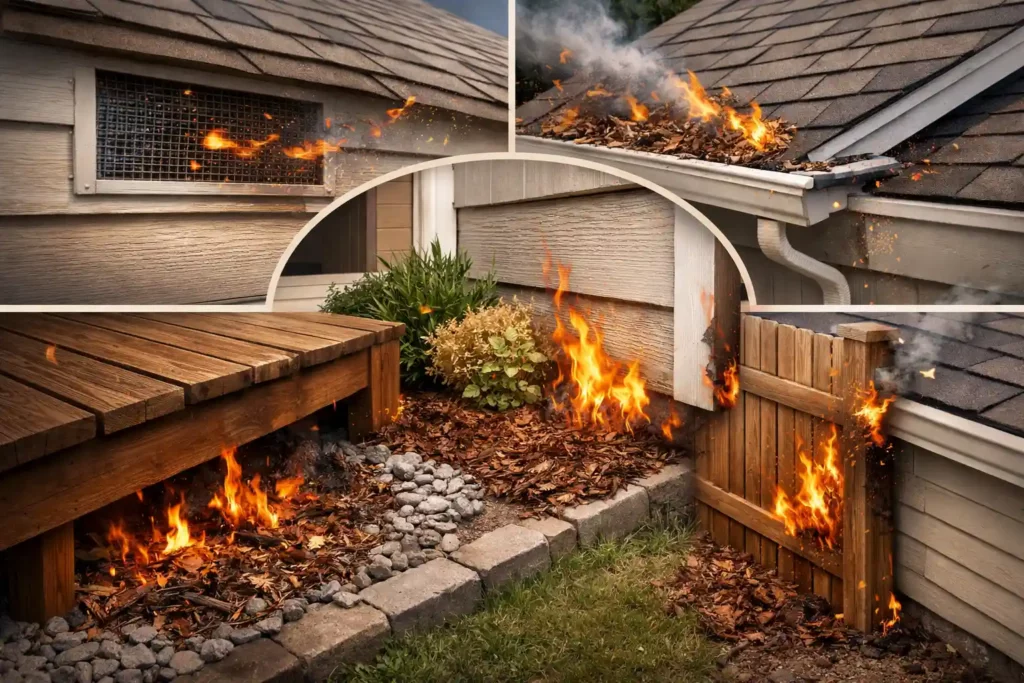
Wildfire investigators often find the same vulnerabilities repeated across burned properties. These weak points allow embers to accumulate or enter the structure.
The most common ignition locations include:
Vent Openings
Attic, soffit, and crawlspace vents allow airflow but can also allow embers to enter if they are not properly protected.
Roof Valleys and Gutter Lines
Debris accumulation creates fuel beds where embers can ignite dry leaves and needles.
Deck Surfaces and Under-Deck Areas
Embers can collect beneath decks where dry vegetation or stored materials are present.
Fence-to-Home Connections
Wood fencing attached directly to a structure can act as a fire pathway if the fence ignites.
Mulch and Landscaping Near Siding
Combustible ground cover within the first few feet of the home significantly increases the risk of ignition.
Addressing these predictable ignition points is one of the most effective ways to strengthen WUI home protection and reduce wildfire vulnerability.
Predict. Plan. Perform: Your DIY Wildfire Protection Blueprint
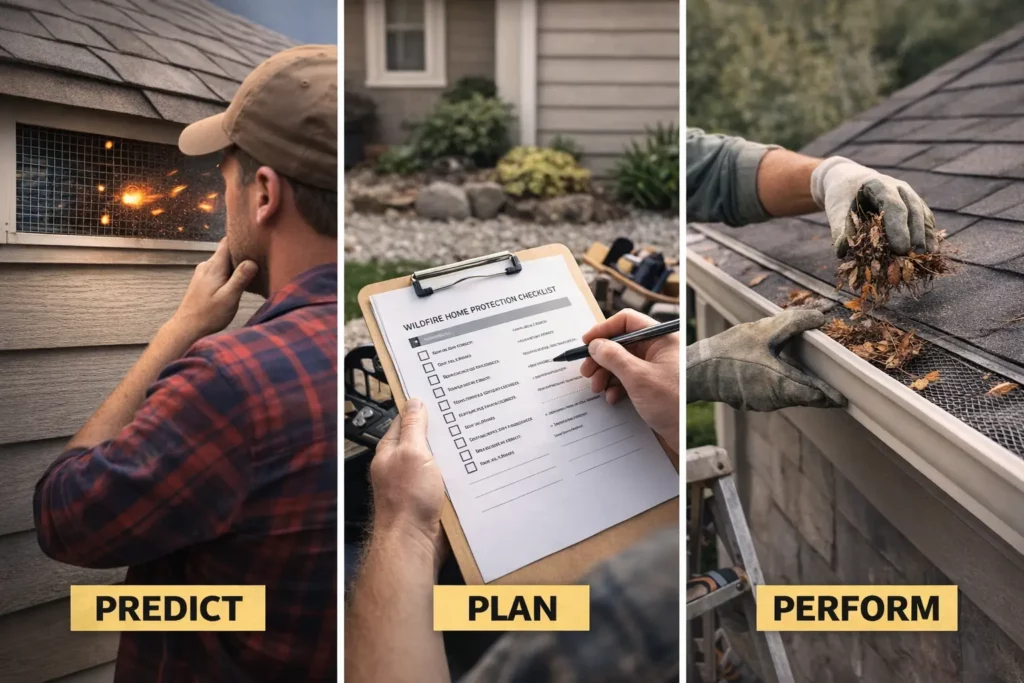
Effective home wildfire protection does not require a complete home rebuild. Instead, it begins with a systematic approach to identifying vulnerabilities and addressing them over time. Firestorm® ‘s Predict. Plan. Perform. framework helps homeowners move from uncertainty to action.
Predict
The first step is identifying potential ignition pathways.
Walk around the home and examine common vulnerability points:
- Vent openings
- Rooflines and gutters
- Deck connections
- Fence attachments
- Landscaping near the structure
Look for areas where embers could accumulate or enter the building envelope.
Plan
Once vulnerabilities are identified, prioritize improvements based on risk and budget.
Start with the highest-impact upgrades:
- Clearing debris from Zone 0
- Improving vent protection
- Installing ember-resistant mesh
- Managing vegetation and mulch
These steps significantly reduce ignition risk while remaining accessible for DIY homeowners.
Perform
Wildfire resilience is built through consistent maintenance and gradual upgrades.
Establish a seasonal maintenance schedule that includes:
- Gutter cleaning
- Vent inspections
- Vegetation management
- Roofline debris removal
Over time, these actions transform wildfire preparation from a one-time project into a long-term resilience strategy.
Moving From Victim to Victor: Building True Home Resilience
Wildfires are a natural part of many ecosystems. As climate patterns shift and development expands into wildfire-prone areas, these events are likely to continue, and at greater frequency.
However, the destruction of homes is not inevitable.
Research from wildfire investigations consistently shows that many losses occur due to small, preventable vulnerabilities. When these weaknesses are addressed, homes have a much greater chance of surviving even intense wildfire events.
This shift requires a new mindset.
Instead of viewing wildfire as an uncontrollable disaster, homeowners can approach it as a manageable engineering challenge. By strengthening vulnerable components and eliminating ignition pathways, the odds of survival improve dramatically.
When entire neighborhoods adopt these strategies, the impact becomes even more significant. Hardened homes reduce the spread of fire between structures and help communities recover more quickly after wildfire events.
Home resilience ultimately benefits not just individual properties, but entire communities.
Fire Is Inevitable. Home Loss Is Not.
Wildfire preparedness also grows stronger when neighbors act together. Homes that eliminate ignition risks help prevent structure-to-structure fire spread, which is a major driver of neighborhood loss during large wildfire events. When communities adopt defensible space practices, improve ember protection, and maintain properties consistently and intentionally, the entire area becomes more resilient.
This is why wildfire mitigation programs increasingly emphasize community-level home hardening, not just individual property upgrades. Every cleared gutter, protected vent, and maintained defensible space zone contributes to a broader network of protection.
Small improvements made today can significantly influence how a neighborhood performs during the next wildfire event.
Preparation doesn’t have to mean expensive reconstruction or specialized equipment. It begins with understanding how wildfires behave and removing the vulnerabilities that embers depend on.
To learn more about ember protection systems and wildfire defense strategies, explore additional resources or contact the Firestorm® team for guidance.

