

You installed mesh over your vents. You figured something was better than nothing, and maybe you even heard that 1/8-inch mesh is the standard. So why did your home still fail a wildfire inspection?
Most standard mesh products—including the widely used hardware cloth—were never designed for wildfire exposure and have not been evaluated against the standards inspectors actually use. That gap between what homeowners assume and what codes require is exactly where most vent failures happen.
This article explains what those standards are, why common mesh solutions fall short, and how to choose vent protection that holds up when it matters most.
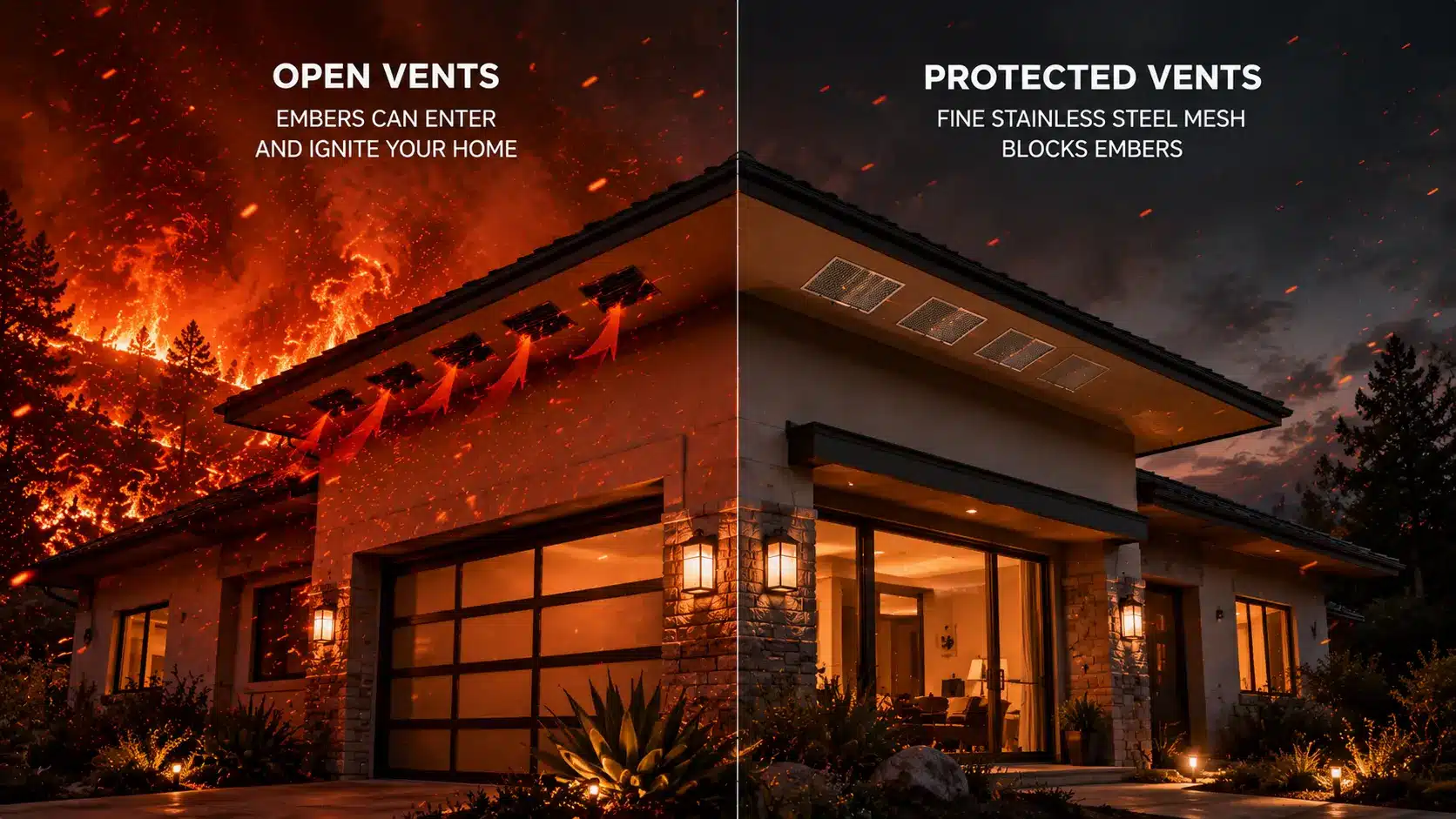
Why Most Vent Mesh Fails Wildfire Inspections
Inspections for wildfire compliance aren’t just about checking whether vents are covered. They’re evaluating whether your protection actually works under fire conditions, and that’s a very different question.
Several inspection triggers can bring this scrutiny to your door:
- AB 38 (California): Requires a home-hardening inspection before a home in a high-fire-hazard zone can be sold.
- WUI (Wildland-Urban Interface) inspections: Local fire authorities assess homes in fire-prone areas for code compliance, often as part of community-wide hardening programs.
- Insurance reviews: Carriers are increasingly requiring documentation of ember-resistant features as a condition of coverage or renewal.
In each of these scenarios, an inspector looks for verified performance, beyond just the presence of a screen. Standard mesh simply isn’t built to pass that test.
The Problem With Hardware Cloth and Basic Mesh
Hardware cloth is a practical material. It keeps pests out, controls gaps, and is easy to find at any hardware store. And that’s what it was designed for…not for wildfire defense.
Here’s where it fails in a fire scenario:
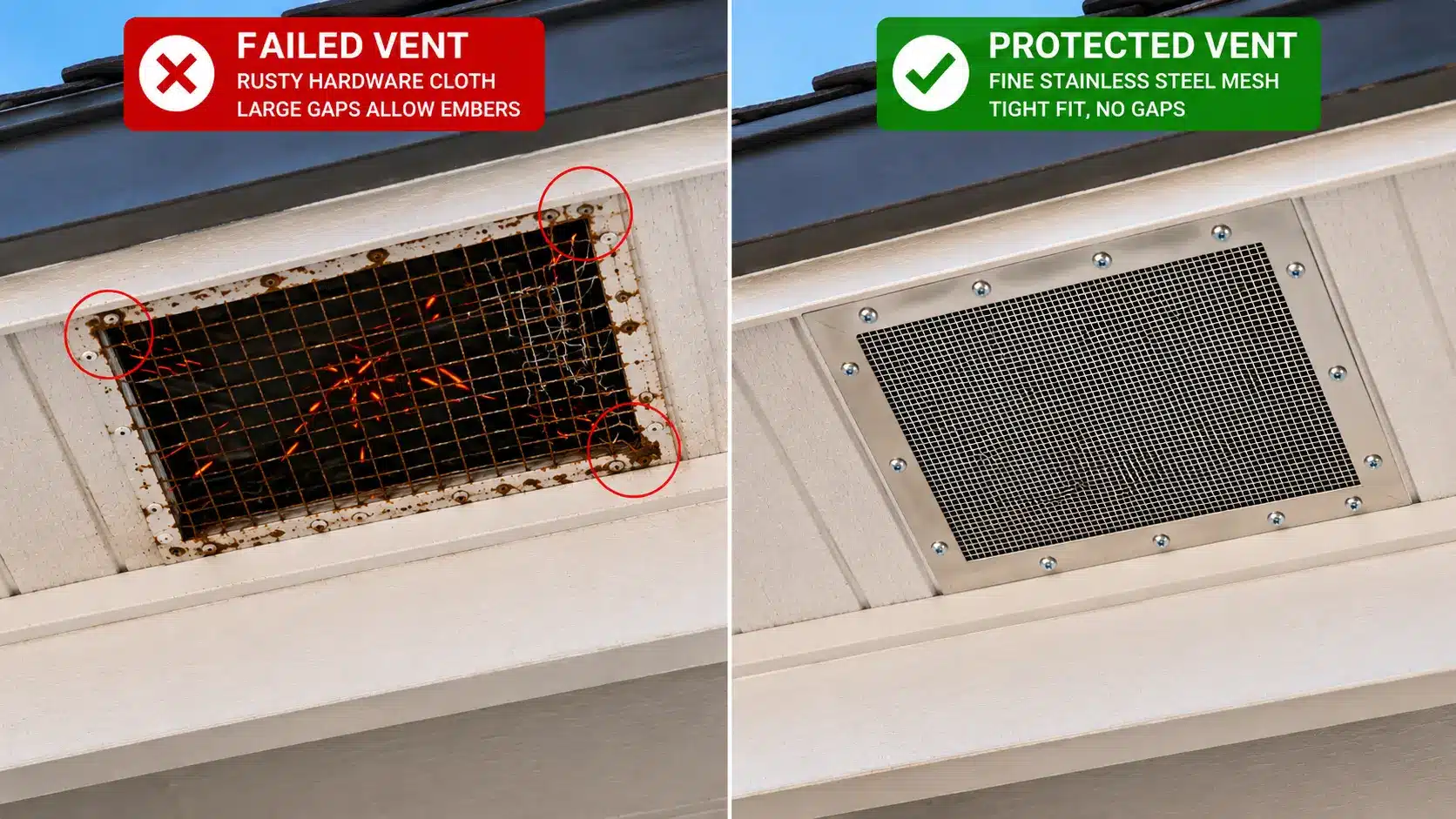
- Opening size alone isn’t enough. The common belief that 1/8-inch mesh meets wildfire code is a misconception. Mesh opening size is one factor, but no amount of mesh size compensates for untested performance under ember exposure.
- Hardware cloth is not tested for ember intrusion. ASTM E2886—the standard that measures how well a vent resists ember entry—is simply not applied to hardware cloth. Without that testing, there’s no verified data to present to an inspector.
- Heat can degrade non-rated materials. Standard galvanized or plain steel mesh can warp, oxidize, or fail structurally during the heat exposure that precedes direct flame contact. Once the mesh fails, the opening is unprotected.
The result: a screen that looks like protection but provides none that’s documented or code-recognized.
What Inspectors Actually Look for in Vent Compliance
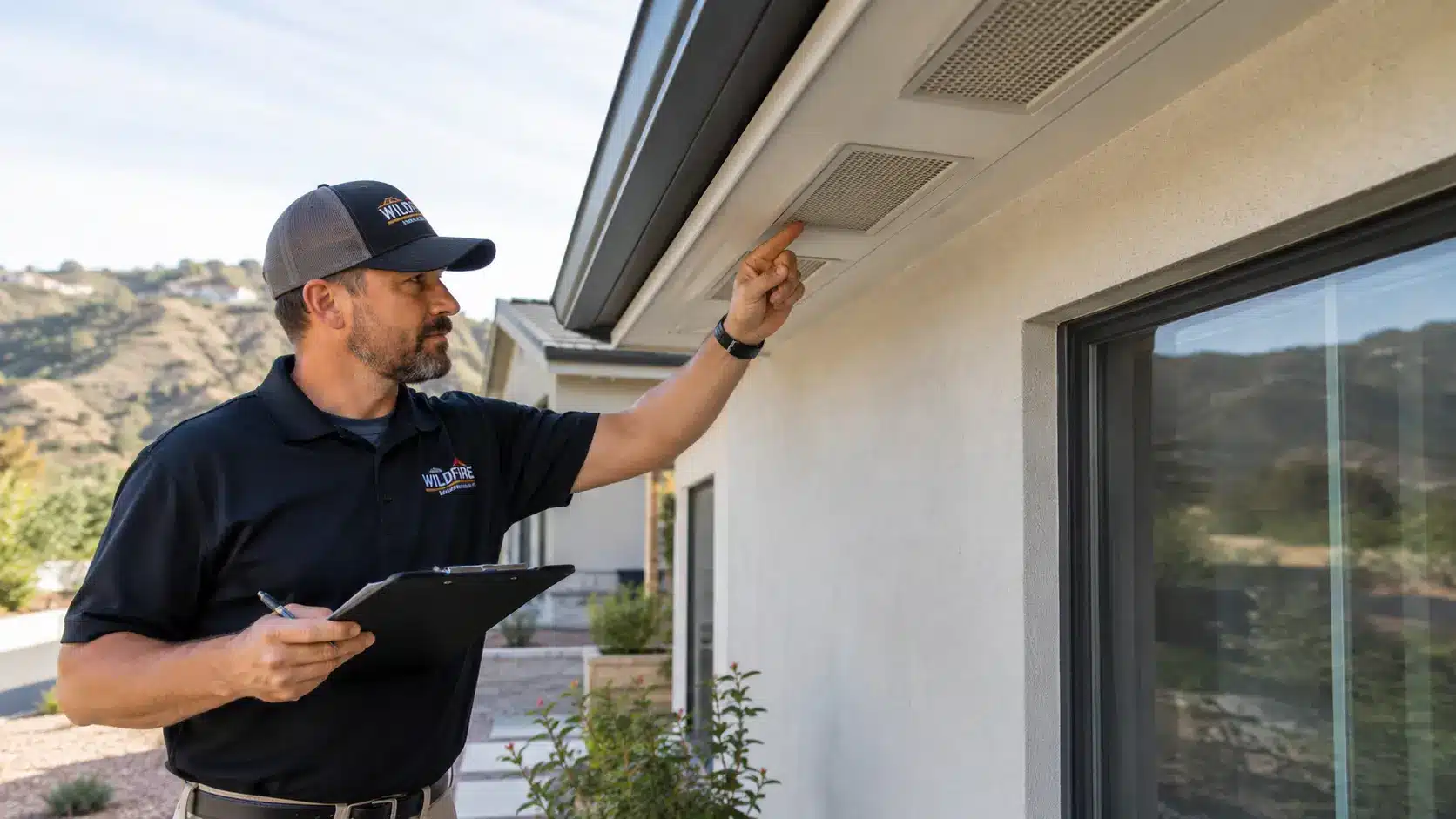
When a wildfire inspector or Authority Having Jurisdiction (AHJ) evaluates your vents, they’re asking four questions:
- Is the mesh opening size within acceptable limits? (Typically 1/16″ to 1/8″ depending on jurisdiction and application.)
- Has the product been tested for ember resistance—specifically per ASTM E2886?
- Is the vent a listed assembly? Meaning tested as a complete system, not just the screen material?
- Was it installed correctly, with no gaps that could allow ember bypass?
The distinction between “listed” and “non-listed” vents matters here. A listed ember vent has been evaluated as a complete system under standardized conditions. Hardware cloth stapled over an opening is not a listed assembly, regardless of the mesh size. Inspectors know the difference.
What ASTM E2886 Tests
ASTM E2886 is the standard that defines what it means to be ember-resistant and it’s the benchmark inspectors reference when evaluating vent compliance.
In plain terms, the standard tests three things:
- Ember intrusion resistance: A simulated ember storm is directed at the vent assembly to assess whether embers can enter the opening.
- Flame exposure response: The vent is exposed to direct flame impingement to evaluate the material and assembly’s response.
- Airflow performance: The standard also considers whether the product maintains adequate ventilation, because a vent that blocks airflow entirely creates its own problems.
The keyword in all of this is “assembly.” ASTM E2886 tests the vent as a complete system, not just the mesh screen. That’s why a hardware cloth patch, however carefully installed, can’t earn a passing designation under this standard. There’s simply no mechanism for it to be listed.
Firestorm EmberMesh™ and EmberVent™ are independently evaluated to ASTM E2886, along with ASTM E84 (surface burning characteristics) and ASTM E2768 (extended ignition resistance). Third-party certification through QAI (Listing #B1155) validates that testing.
Ember-Resistant Mesh vs. Hardware Cloth: A Side-by-Side Comparison
How the two approaches compare across factors inspectors and homeowners should care about most:
| Feature | Hardware Cloth / Standard Mesh | Firestorm EmberMesh™ / EmberVent™ |
| Ember Blocking | ❌ Limited; not tested for ember intrusion | ✅ Engineered to block wind-driven embers |
| ASTM E2886 Tested | ❌ No | ✅ Yes; independently verified |
| Code Compliant (Chapter 7A / WUI) | ❌ Not listed; does not meet code | ✅ Listed and compliant (vertical installs) |
| Material Integrity Under Heat | ❌ May warp, corrode, or fail | ✅ 304 stainless steel, built to last |
| DIY Retrofit Friendly | ⚠️ Installable, but non-compliant | ✅ Designed for easy retrofit |
| Inspection Ready | ❌ Likely to trigger failure | ✅ Supports inspection success |
The bottom line: hardware cloth may physically fill a gap, but it doesn’t do so in any way that matters to an inspector, an insurer, or a wildfire.
Why “1/8-Inch Mesh” Alone Is Not Enough
The 1/8-inch mesh standard has been around long enough that many homeowners treat it as a compliance checkbox. It isn’t.
Under California’s Chapter 7A, the primary building code governing construction in high fire-hazard severity zones, vent protection requirements extend beyond mesh size. The code references listed assemblies and tested performance. Mesh size is a specification; it is not a performance result.
Think of it this way: two products can both measure 1/8-inch aperture. One has been independently tested for ember intrusion under wind-driven conditions. The other has not. To an inspector, these are not equivalent, and in a real fire event, they absolutely aren’t.
Chapter 7A and the International Wildland-Urban Interface Code (IWUIC) both require that vent protection in WUI zones meet verified performance standards. Meeting the spirit of those requirements means choosing a product that has actually been tested, not one that approximates the right dimensions.
Why Non-Compliant Vents Fail Inspections
Beyond the technical gap in testing, there’s a practical enforcement reality: inspectors can only approve what they can verify.
Authorities Having Jurisdiction (AHJs) enforce Chapter 7A, WUI codes, and local amendments. When they evaluate a home, they look for listed products; items that appear in recognized compliance directories and can be traced to third-party testing. Hardware cloth doesn’t appear in those directories. There’s no listing number to reference, no certification to produce.
Insurance implications add another layer. As wildfire risk increases across the West, carriers are requiring homeowners to demonstrate hardening measures. A home protected by non-compliant mesh may not qualify for discounts—or may face coverage limitations—simply because the protection can’t be documented.Inspection failure isn’t a judgment on your effort. It’s a documentation problem. And the solution is choosing products that come with verifiable credentials.
Fire-Rated Vent Screens vs. DIY Mesh Fixes
There’s an important distinction between a fire-rated vent screen and a DIY mesh solution, and it goes beyond price.
A fire-rated vent screen or listed vent assembly has been engineered, tested, and certified as a complete system. The frame, mesh, fastening method, and installation orientation are all part of the evaluation. When you install a listed product correctly, you’re doing more than simply covering an opening; you’re deploying a system that has been verified to perform.
A DIY mesh fix—even one made with quality materials installed by a capable homeowner—lacks that system-level testing. The mesh might be appropriate. The framing might be solid. But without the ASTM listing, the combination hasn’t been proven to perform under the conditions that matter.
That said, DIY is not automatically wrong. Firestorm EmberMesh™ is specifically designed to be DIY-friendly and can be a compliant solution when installed correctly in the right applications. The question is whether you’re using a product that’s actually been tested, not just a material that seems similar.
When Retrofit Mesh Works and When It Doesn’t
Retrofit ember mesh is a legitimate and often ideal solution under the right conditions. Here’s how to think about it honestly:
Retrofit mesh is likely appropriate when:
- Your existing vent frame is intact and structurally sound.
- The opening is vertical (mesh-only solutions are generally not approved for horizontal installations in WUI zones).
- You’re using a listed, ASTM E2886-tested product like Firestorm EmberMesh™.
- Installation follows manufacturer specifications, with fastener spacing no greater than 6″ and no gaps larger than 1/16″.
Full vent replacement may be required when:
- The existing vent is damaged, corroded, or structurally compromised.
- Your jurisdiction requires a listed vent assembly (not just mesh) for your specific vent type or location.
- The vent is in a horizontal orientation where mesh-only solutions may not be code-compliant.
When in doubt, consult your local building department or a qualified contractor before assuming retrofit is sufficient.
How to Choose a Compliant Vent Solution
If you’re shopping for vent protection, whether you’ve just failed an inspection or you’re getting ahead of fire season, here’s a practical checklist:
| Question | What to Look For |
|---|---|
| Is it ASTM E2886 tested? | Look for independent third-party certification, not just a manufacturer’s claim. |
| Is it code-compliant for your jurisdiction? | Confirm it meets Chapter 7A, WUI, or your local AHJ requirements. |
| Is it a listed vent assembly or just mesh? | Listed assemblies are tested as complete systems, not just the screening material. |
| Is it properly installed? | Even compliant products fail if there are gaps, improper fastening, or wrong orientation. When in doubt, consult a qualified contractor. |
| Does it work for your application? | Mesh retrofits can be appropriate for some scenarios; full vent replacement may be required for others. |
Firestorm EmberMesh™ and EmberVent™ are designed to meet all of these criteria: independently tested, code-compliant for vertical applications, and engineered for straightforward DIY installation.

Vent Protection Within a Complete Wildfire Strategy
Compliant vents are a critical layer of wildfire defense, but they work best as part of a larger system. Embers that enter through vents are responsible for the majority of home ignitions in wildfires, but embers can also accumulate in gutters, collect against rooflines, and travel into any gap in your home’s exterior envelope.
A complete home hardening approach includes:
- Ember-resistant vents and mesh on all vent openings.
- Fire-rated gutter guards to prevent ember accumulation and reduce ignition risk along rooflines.
- Ember-resistant skirting for decks and exposed under-floor spaces.
- Defensible space cleared and maintained vegetation zones around your home.
- Regular debris removal from gutters, vents, and roof valleys, especially during fire season.
No single product eliminates wildfire risk. But each layer you add reduces your home’s vulnerability, and gives you a documented record that matters to inspectors and insurers alike.
Inspection Failure Is Predictable and Preventable
If your vents failed a wildfire inspection, it almost certainly wasn’t because you didn’t try. It’s because the products available at most hardware stores weren’t designed with wildfire code compliance in mind, and the inspection process is de signed to catch exactly that gap.
The path forward is straightforward: choose vent protection that has been independently tested to ASTM E2886, listed for compliance, and installed correctly for your application. That’s the difference between a fix that looks right and one that actually is.
Firestorm EmberMesh™ and EmberVent™ are built for this. Tested. Listed. DIY-friendly. Designed to protect your home and give you the documentation to prove it.

