

What Does a Wildfire Defense System Do? Why Your Current Vents Aren’t Part of One
Most homeowners think wildfire defense means a fire truck in the driveway. Sprinklers on the roof. Maybe a cleared yard. Something reactive, something that shows up after the threat is already visible.
Real wildfire defense starts at the structure, long before any flame gets close. And for most homes, that defense doesn’t exist yet.
This article explains what a true wildfire defense system is, why most homes in fire-prone areas lack one, and what it actually takes to build meaningful protection.
The Reality of Wildfires: The Danger Isn’t Just the Flames, It’s the Embers
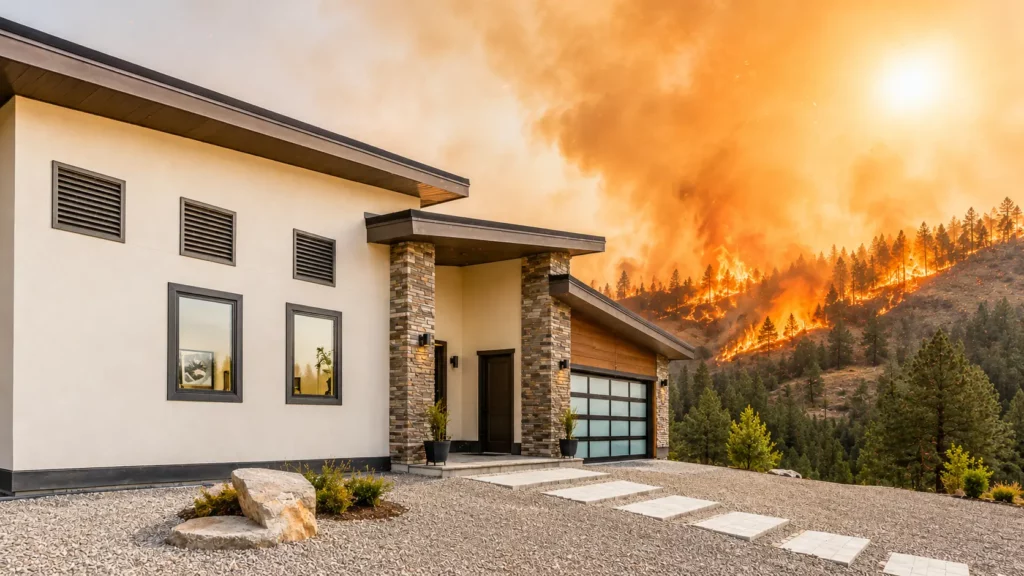
The dominant image of wildfire destruction—a wall of fire consuming everything in its path—is real, but it’s not usually what destroys homes. Research consistently shows that up to 90% of structures lost in wildfires are ignited by wind-driven embers, not direct flame contact.
Embers are small, numerous, and fast. During major wildfire events, burning vegetation and structures produce millions of fragments that are lifted by updrafts and carried by the wind, sometimes for more than a mile ahead of the fire front. When those embers land on or near a structure, they probe for any opening: a vent gap, accumulated debris in a gutter, a gap under deck skirting, a crack in an eave.
This is ember intrusion, the process by which a wildfire enters a home not through its walls but through its vulnerabilities. Ember intrusion prevention is the foundational goal of any serious wildfire defense strategy. For a closer look at the mechanics of how this happens, Firestorm’s guide to how embers ignite homes breaks down the ignition sequence in detail.
What Is a Wildfire Defense System?
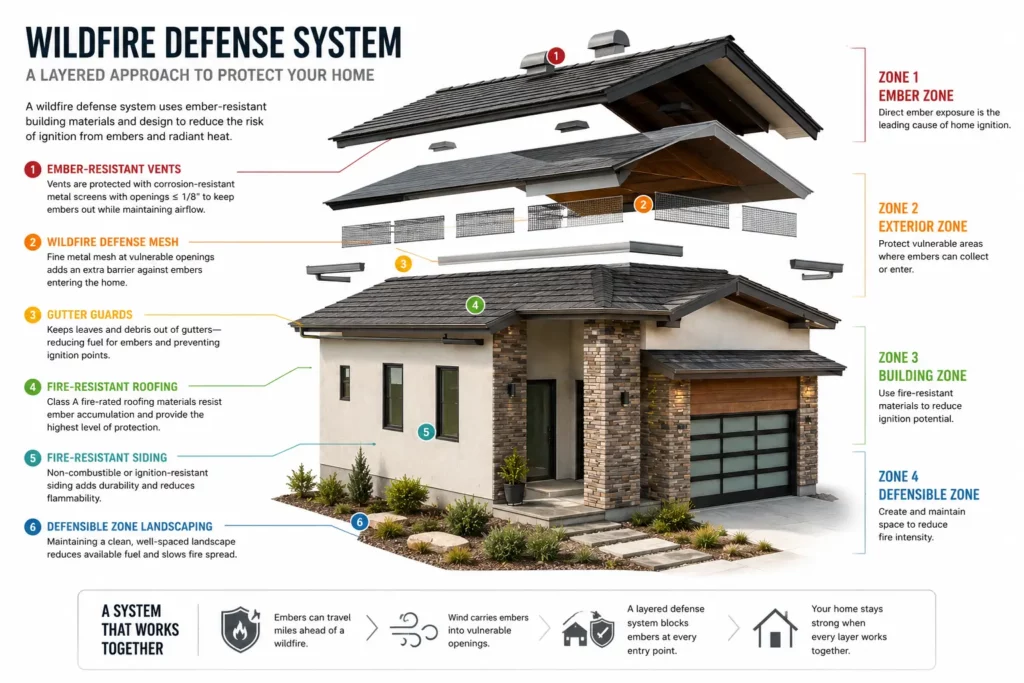
A wildfire defense system is a combination of engineered building components working together to prevent ember entry, reduce ignition risk, and protect vulnerable points across the entire structure.
The operative words are working together. A single upgraded product — a new vent here, some mesh there — creates localized improvement without systemic protection. Embers don’t target one spot. They saturate a structure under wind pressure, finding any gap that lets them through. A system closes those gaps in sequence: at the vent, at secondary openings, and at the roofline fuel source.
What a wildfire defense system is not: a fire suppression system, a defensible space plan, or a substitute for vegetation management. Those are complementary layers. The defense system addressed here lives at the structure itself.
The 3 Core Components of an Effective System
Ember-Resistant Vents
Vents are the most common ember entry point on a home. Attic vents, soffit vents, gable vents, dormer vents, and foundation vents are all open by design — they exist to move air. During a wildfire, they move embers with equal efficiency.
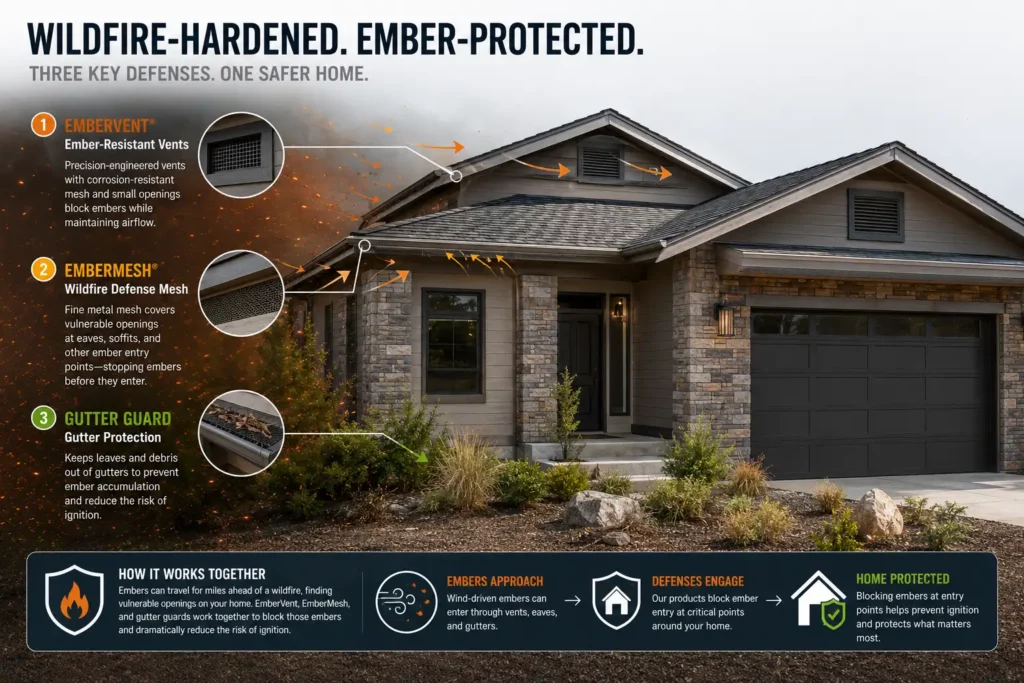
Standard vents offer no meaningful resistance. Engineered solutions like EmberVent™ are built specifically for wildfire conditions: fine-gauge noncombustible metal mesh, internal baffle systems, and materials rated to ASTM E-84, E-2768, and E-2886. They block ember intrusion while maintaining the airflow your attic needs. They are the first line of the system — and the most critical one to get right.
Wildfire Defense Mesh
Vents aren’t the only openings on a structure. Deck skirting, eave gaps, crawlspace perimeters, fence connections, window screens, and enclosed outdoor spaces all represent potential ember pathways that standard vent upgrades don’t address.
EmberMesh™ is an engineered wildfire-defense mesh designed to close those secondary vulnerabilities. Rated to the same ASTM standards as EmberVent™ and available in multiple widths, it functions as a flexible barrier across any opening where embers might accumulate or penetrate. The distinction between engineered wildfire defense mesh and standard hardware cloth matters here, and it’s covered in the next section.
Gutter Protection Systems
Gutters are one of the most overlooked ignition points on a home. Leaf litter, pine needles, and organic debris accumulate in gutters over time, creating a ready fuel bed at the roofline, precisely where embers land and collect under wind pressure.
A burning ember that lands in a debris-filled gutter doesn’t need to find a vent. It finds fuel. FireStorm® Gutter Guards eliminate that fuel load by blocking debris accumulation while maintaining drainage function. Gutter protection is the third leg of the system, and without it, the roofline remains a meaningful ignition risk regardless of how well the vents and mesh perform.
Why Standard Mesh and Vents Fail During Wildfires
The hardware cloth and standard mesh screens on most homes aren’t tested for wildfire exposure. They’re designed for pest exclusion and airflow, not for the combination of radiant heat, sustained ember contact, and wind pressure that a wildfire event produces.
The specific failure points:
Mesh opening size. Common 1/4″ hardware cloth allows embers to pass through freely. Even 1/8″ mesh—an improvement—is the minimum threshold under Chapter 7A, not the optimal standard. IBHS Wildfire Prepared certification requires 1/16″ or ASTM E2886-listed vents.
Material composition. Fiberglass and plastic mesh components melt or ignite under elevated heat, eliminating their protective function at the worst possible moment.
No ember testing. Standard products are not evaluated under conditions that replicate actual wildfire exposure. There’s no validation that they perform when performance is required.
The danger of standard solutions isn’t just that they’re insufficient; it’s that they create a false sense of security. A homeowner who has replaced old screens with new hardware cloth may believe they’ve addressed ember intrusion. They haven’t.
The Difference Between a Product and a System
Upgrading one vent is not wildfire protection. It’s a single improvement in a structure that has dozens of potential entry points.
This distinction matters because ember attacks don’t respect selective upgrading. Wind-driven embers under wildfire conditions probe a structure under pressure across its entire surface. A protected vent next to an unprotected soffit gap still results in ember intrusion through the soffit gap.
A wildfire defense system addresses the structure as a whole: primary vent openings, secondary gaps and penetrations, and roofline fuel accumulation. The components are individually valuable; the system is what produces meaningful risk reduction.
How a Wildfire Defense System Works Together
The three components address different but connected vulnerabilities:
- EmberVent™ closes the primary entry points, the designed openings in your building envelope, with tested, listed ember resistance.
- EmberMesh™ closes the secondary gaps, the unintended openings, and exposed spans that vents alone don’t cover.
- FireStorm® Gutter Guards eliminate the roofline fuel source that turns an ember landing into a structural ignition.
Together, they interrupt the ember intrusion sequence at three distinct points. A spark that gets past the gutter guard faces the vent. A spark that finds a secondary gap faces the mesh. The system creates redundancy, which is the only reliable approach when the threat is measured in millions of airborne fragments.
Do You Already Have a Wildfire Defense System?
- Are your vents rated to ASTM E2886 or covered with 1/16″ noncombustible metal mesh?
- Has your mesh been tested for ember and flame exposure, beyond pest exclusion?
- Are all vent locations covered: eave, soffit, gable, dormer, and foundation?
- Are secondary gaps (deck skirting, crawlspace perimeters, eave openings) protected?
- Are your gutters guarded against debris accumulation at the roofline?
If any answer is no or uncertain, your home has addressable vulnerabilities, and the protection you think you have may not hold under real wildfire conditions.
Building a Real Defense Strategy for Your Home
Start with a vulnerability assessment, not a product list. Walk the structure and identify every opening: where are the vents, what are they made of, what gaps exist beyond the vents, and what’s collecting in the gutters. That inventory tells you where to prioritize.
Most homeowners don’t need to upgrade everything at once. The highest-leverage sequence is typically vents first (primary entry points), mesh second (secondary gaps), gutters third (roofline fuel). Work in phases if needed, but understand that each phase leaves the unaddressed vulnerabilities in place.
Firestorm’s ultimate home wildfire protection guide walks through the full assessment and upgrade process in detail, from understanding how embers exploit specific vulnerabilities to choosing the right products for each location.
For the component-level specifics, EmberVent™, EmberMesh™, and fire-resistant vents are all documented on the Firestorm site with specifications, ratings, and available sizes.
A Proactive System, Not a Reaction
Wildfire defense systems work because they’re proactive and structural, as they arrive after the threat does. Embers are the real mechanism of home loss in WUI zones, and standard vents and mesh are not designed to stop them.
The gap between what most homes have and what a real wildfire defense system provides is significant, but it’s also closeable. If you’re not sure where your home stands, that’s the right place to start.

