

Wildfires don’t stop at property lines, and neither does the financial pressure they create for communities trying to get ahead of the risk. HOA boards in California’s wildland-urban interface are increasingly responsible for community-wide wildfire preparedness, often without a clear funding path to support it.
The 2026 State Fire Capacity (SFC) Grant Program, administered by the California Fire Safe Council (CFSC) and funded by the U.S. Forest Service, is one of the most accessible wildfire mitigation funding opportunities available to HOAs. Understanding how it works and how to position a community for the next cycle is worth the time of any board that’s serious about wildfire preparedness.
What Is the 2026 SFC Grant?
The State Fire Capacity Grant Program is a federal funding mechanism designed to help California communities respond to catastrophic wildfire risk. CFSC administers the program using funding from the U.S. Forest Service’s Cooperative Fire Program.
The key numbers:
- Total program funding: $600,000 available statewide
- Maximum per applicant: Up to $200,000 in federal funds for a 24-month period of performance
- Grant term: October 1, 2026, through September 30, 2028
- Application portal: ZoomGrants
Home and property owners associations are explicitly listed as eligible applicants, alongside nonprofits, municipalities, tribes, resource conservation districts, and other entities. For-profit organizations are not eligible.
One important eligibility note: applicants must have completed at least one independent financial audit within the past two years. Unincorporated HOAs without legal standing will need to identify a fiscal sponsor to administer funds.
How HOAs Can Use the Funds
The SFC grant supports three categories of work that are directly relevant to HOA-managed communities:
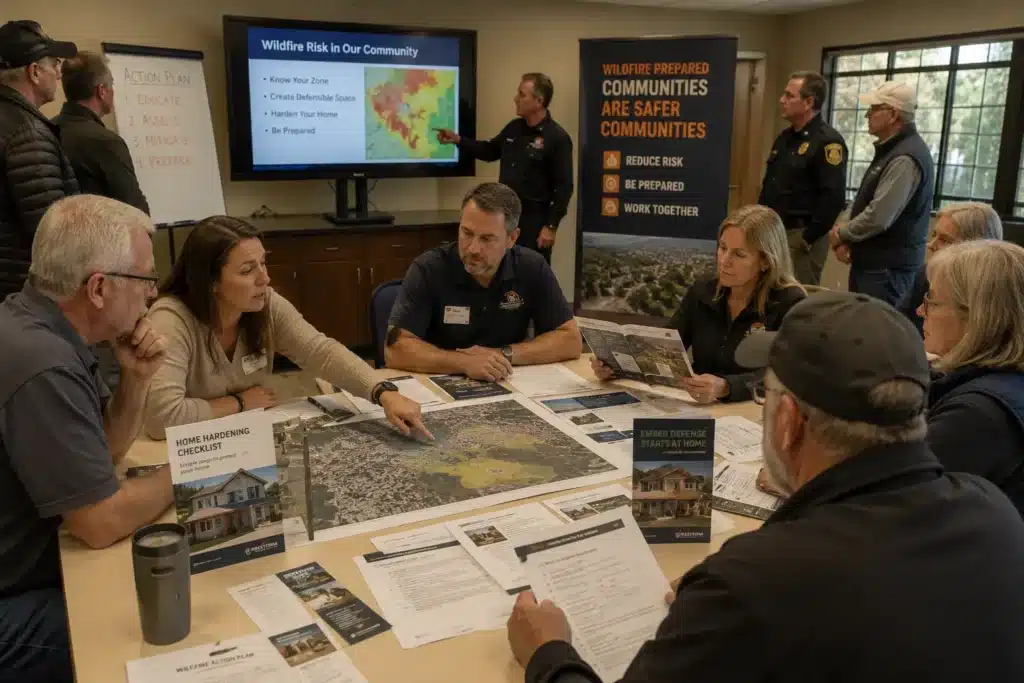
Prevention and Mitigation Education: This is where Firestorm’s expertise integrates most naturally. Eligible activities include homeowner workshops, mailing campaigns, educational resource development, and home ignition zone inspections. HOA boards can use grant funding to deliver professional home-hardening education—including how products like EmberVent™ and EmberMesh™ address ember intrusion—directly to residents.
Community Hazard Mitigation Planning: Funds can support the development or update of a Community Wildfire Protection Plan (CWPP), Firewise USA community development, or other wildfire mitigation assessments. For HOAs that haven’t yet formalized a wildfire preparedness framework, this is a significant opportunity. Firestorm’s Firewise communities guide explains how that designation works and what it means for neighborhood-wide resilience.
Fuel Hazard Mitigation: Chipping, thinning, grazing, mastication, and roadside fuel break programs are all eligible activities. For communities with significant common-area vegetation, this category can fund the kind of large-scale fuel reduction that individual homeowners can’t accomplish on their own.
Understanding the Cost-Share Requirement
The SFC grant requires a 1:1.5 match, meaning for every $1.00 in federal funding received, the applicant must contribute $1.50 from non-federal sources toward the total project cost.
In practical terms, a community applying for the maximum $200,000 would need to demonstrate $300,000 in matching contributions, for a total project budget of $500,000.
That sounds substantial, but the match can include in-kind services and donated goods—not just cash. This is where a partnership with a home hardening company like Firestorm creates real value. Product demonstrations, educational materials, and in-kind resource contributions from a third-party vendor can count toward the HOA’s matching obligation, depending on how the project budget is structured. If you’re considering applying, discuss this with CFSC’s grant team and document partner contributions carefully from the start.
What Strengthens an HOA Application
Grant applications are scored competitively, and communities that demonstrate planning depth and community risk tend to perform better. A few factors worth building into your application:
Location in a designated high-risk area. The SFC program prioritizes communities facing documented wildfire exposure. If your HOA falls within a Very High Fire Hazard Severity Zone or appears on the California Fire Alliance “Communities At Risk” list, make that visible in your application narrative.
A connection to existing planning frameworks. Applications tied to an existing or in-development CWPP, Firewise USA recognition, or documented community mitigation history tend to demonstrate the kind of organizational readiness CFSC looks for.
Realistic project scope. The NOFO is explicit: applicants should only request what they can reasonably spend within the 24-month performance window. Overreaching on scope is a common application weakness.
Education paired with proven hardening solutions. Workshops are more effective when residents leave with a clear understanding of what to do and access to fire-resistant vents and California home-hardening resources that match their specific vulnerabilities. Applications that connect education to actionable outcomes are stronger than those that treat outreach as a standalone deliverable.
A Note on the Application Timeline
The 2026 SFC cycle opened April 1, 2026, and closed May 15, 2026. Grant awards are expected to be announced in late summer 2026. If your community missed this cycle, the time between now and the next application window is exactly when groundwork should be laid, financial audits completed, a fiscal sponsor identified if needed, SAM/Unique Entity ID registration started (which can take time), and a project scope developed.
The Application Guide PDF from CFSC walks through every requirement in detail and is worth reviewing well before the next cycle opens.
Your Community’s Next Step Toward Funded Wildfire Protection
Federal funding for community wildfire mitigation exists, and HOAs are explicitly eligible to access it. The SFC grant supports education, planning, and fuel reduction; three categories that can meaningfully reduce wildfire risk across an entire community when executed well.
The match requirement means HOAs shouldn’t apply alone. Building partnerships with home hardening vendors, local fire safe councils, and community organizations before the application window opens gives you the best chance of meeting both the funding threshold and the competitive scoring criteria.
Contact Firestorm Building Products to discuss how educational resources, product demonstrations, or in-kind partnership documentation can support your HOA’s next grant application, and help your community build the kind of structural resilience that holds up when it matters.

