

There’s a version of this question that feels obvious. Of course, a gutter guard keeps debris out; that’s what it’s for. But a version that most homeowners in wildfire-prone areas have never thought to ask: does it also stop embers?
Those are different questions with different answers, and that difference matters more than most product marketing might suggest. A cover that keeps pine needles out of your gutter channel can still allow wind-driven ember fragments through, depending on how it’s made and what it’s made of. For homeowners in WUI zones, that distinction isn’t academic. It’s the difference between gutter protection and actual wildfire protection.
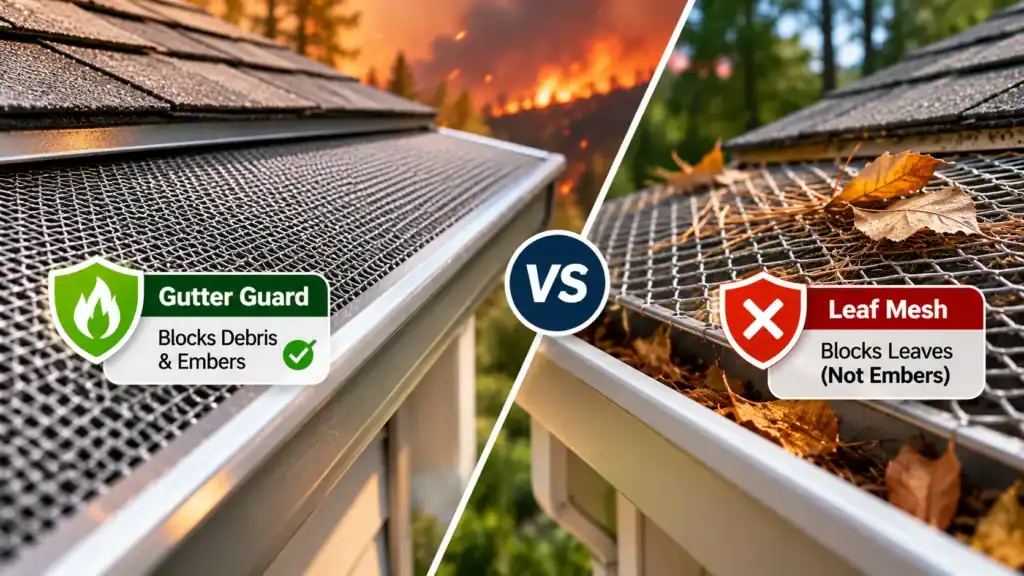
Why Gutters Matter During a Wildfire
Gutters Can Collect Combustible Debris
Left unprotected, gutters accumulate dry leaves, pine needles, seed pods, and organic debris throughout the year. In fire-prone areas, particularly near conifers, that accumulation can be significant even with regular maintenance. Dry organic material compacted in a gutter is fuel sitting at the roofline, exactly where embers land during a wildfire event.
Wind-Driven Embers Add Another Risk
Wind-driven embers during a wildfire don’t follow the fire; they lead it. Embers travel ahead of the front under sustained wind pressure, sometimes for more than a mile. When they reach a structure, the roofline is a natural collection point: wind decelerates at the roof edge, changes direction, and deposits particles on any horizontal surface that slows their movement. Gutters, by design, collect debris horizontally.
An ember that lands in debris-filled gutter has found its fuel. An ember that lands in a clean gutter, or passes through gutter protection that doesn’t block fine particles, still finds a landing point at the roofline, but the question becomes whether the gutter system can stop it from igniting.
Clean Gutters Are Only Part of the Solution
Regular gutter cleaning reduces the fuel load at the roofline, which genuinely helps, but it doesn’t prevent ember accumulation, and it doesn’t address what happens when a gutter guard allows fine ember fragments through. IBHS wildfire research identifies roofline debris accumulation as one of the documented ember ignition pathways on home exteriors. Clean gutters reduce that risk, and gutter guards that prevent debris from accumulating extend the protection between cleanings, but neither replaces protection that also accounts for ember particle size.
Gutter Guards vs. Leaf Mesh: What’s the Difference?
What Traditional Leaf Mesh Does
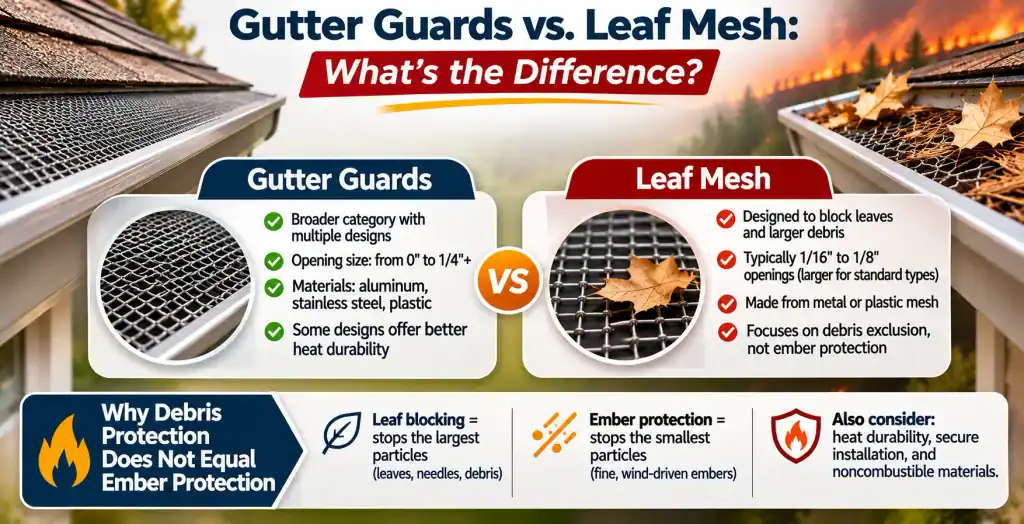
Traditional leaf mesh, the gutter cover category most homeowners encounter at hardware stores, is designed to block leaves and larger debris while letting rainwater pass through. Most products in this category use woven metal or plastic mesh with openings sized to stop leaves: typically 1/16″ to 1/8″ for micro-mesh products, larger for standard screen and foam-insert types.
The primary design objective is debris exclusion, which is a perfectly legitimate and useful goal. It’s also different from ember exclusion, and a product optimized for one doesn’t necessarily perform well at the other.
What Gutter Guards Are Designed To Do
“Gutter guard” is a broad category that includes several distinct designs: solid-surface guards with surface-tension drainage, standard mesh screens, micro-mesh panels, foam inserts, and brush-style inserts. These vary significantly in opening size, material, and how they handle different types of debris.
Opening size ranges from essentially zero (solid-surface guards that rely on water adhesion) to 1/4″ or larger on standard screens. Material ranges from plastic and aluminum to stainless steel. Durability under heat varies from products that melt or warp at moderate temperatures to metal mesh systems that maintain their structure under fire-condition radiant heat.
Why Debris Protection Does Not Equal Ember Protection
The key distinction: leaf-blocking performance depends on the largest particle a product stops. Ember protection is determined by the smallest particle a product stops, and those are different thresholds.
A micro-mesh product with 1/16″ openings might block the vast majority of leaves while still allowing some ember-sized particles through, particularly under the wind pressure that accompanies a wildfire. A solid-surface guard that blocks all debris has zero mesh openings but may have gaps at the gutter attachment point where embers can enter. And any product made with combustible materials, such as plastic, foam, or untreated aluminum alloy, can become a liability when exposed to sustained radiant heat.
The question isn’t whether a gutter cover stops leaves. It’s whether it stops embers, maintains structural integrity under heat, and is made from materials that don’t become a fuel source themselves.
What Makes Gutter Protection Ember Resistant?
Mesh Size and Construction
For gutter protection to reduce ember-entry risk, the mesh or cover needs to address the size of embers under wind-driven conditions, not just leaf size. Fine metal mesh at openings, sized for ember exclusion and applied across the full gutter opening (including attachment edges), addresses this in a way leaf-optimized mesh typically doesn’t.
Construction quality at the edges and seams is equally important. Gaps at the gutter lip, at mitered corners, or at downspout openings create entry points that bypass whatever mesh is present across the main channel. Ember-resistant gutter protection needs to address the full perimeter, not just the horizontal cover surface.
Noncombustible and Heat-Resistant Materials
Material selection matters just as much as opening size. Plastic mesh components, common in consumer-grade gutter guards, can melt or ignite under radiant heat exposure, eliminating their protective function at the worst possible moment. Foam inserts present the same problem and add their own fuel contribution.
Metal mesh systems, such as aluminum or stainless steel, maintain their structural integrity under heat and don’t add combustible material to the roofline. In wildfire-prone areas, noncombustible construction is the baseline requirement.
Testing and Verification
Product descriptions use terms like “fireproof,” “fire-resistant,” and “ember-resistant” without consistent standards behind the language. For vent products, ASTM E2886 provides a standardized testing framework that evaluates performance under simulated wildfire conditions. For gutter guards, no single equivalent standard has been universally adopted — which means homeowners need to look past label language to material specifications, construction details, and any available third-party testing documentation.
If a manufacturer can’t provide specific material specifications and evidence of testing under relevant conditions, “fire-resistant” in the product name is a marketing claim, not a performance guarantee.
How FireStorm® Gutter Guards Address Ember Exposure
Designed for Wildfire Protection
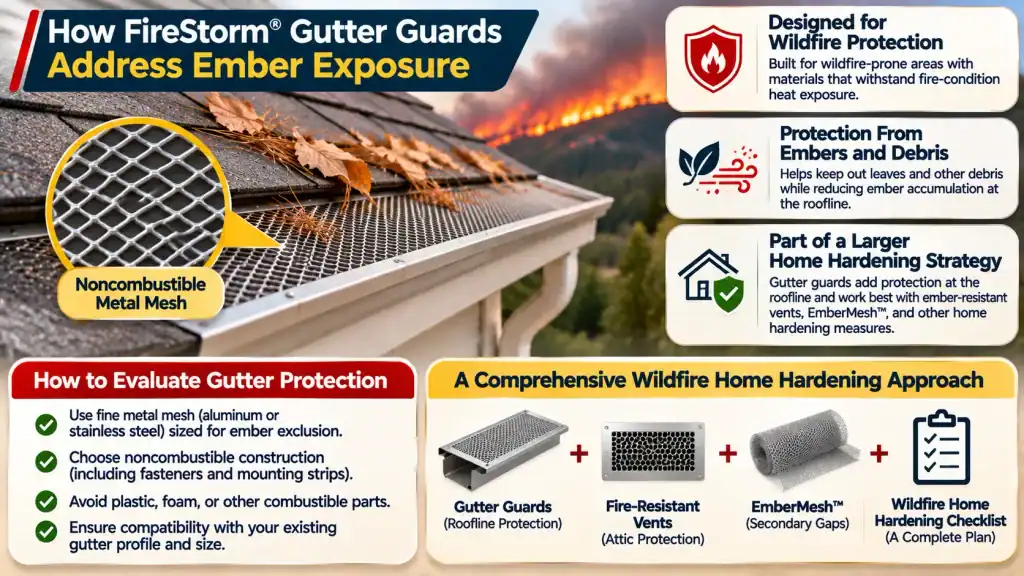
FireStorm® Gutter Guards are designed specifically for wildfire-prone applications. The design objective is to reduce ember accumulation and combustible debris at the roofline, using materials appropriate for fire-condition heat exposure.
Protection From Embers and Debris
FireStorm® Gutter Guards address both the debris fuel load and the ember-accumulation risk—the two distinct wildfire vulnerabilities that gutters present. Metal mesh construction prevents the debris accumulation that creates roofline fuel. The material specification addresses heat exposure in a way that plastic and foam alternatives don’t.
Part of a Larger Home Hardening Strategy
Gutter protection is one layer of wildfire home hardening, not the complete solution. A protected gutter on a home with unprotected attic vents still has an ignition pathway. A clean roofline doesn’t address Zone Zero, defensible space, or the building envelope vulnerabilities that ember-resistant vents address.
For homeowners building a comprehensive approach, FireStorm’s fire-resistant vents, EmberMesh™ for secondary gaps, and Wildfire Home Hardening Checklist cover the rest of the building systematically.
How to Evaluate Gutter Protection for a Wildfire-Prone Home
Check the Opening and Material
Before purchasing, confirm the mesh opening size and material. For WUI-zone applications, look for:
- Fine metal mesh (aluminum or stainless steel) with openings appropriate for ember exclusion — not just leaf blocking
- Noncombustible construction throughout, including attachment hardware and mounting strips
- No plastic, foam, or combustible components in the primary assembly
- Compatibility with your existing gutter profile and size
Consider Your Local Wildfire Exposure
A standard suburban home in low-risk territory and a home in a High Fire Hazard Severity Zone near a wildland edge have different protection requirements. In WUI zones, evaluating gutter protection specifically for ember exposure, not just debris management, is part of responsible homeownership. The same product that works fine for leaf control in a low-risk area may be inadequate for the specific conditions a wildfire produces.

