

If you’ve spent any time researching wildfire home hardening, you’ve likely encountered the term ASTM E2886. It appears in product listings, code references, insurance discussions, and inspection requirements, often without much explanation of what it actually measures or why it even matters.
This blog is designed to close that information gap. ASTM E2886 is the standard that separates vents that have been evaluated for wildfire conditions from vents that haven’t. Understanding the difference will help you make better decisions when it comes to protecting your home.
What Is ASTM E2886?
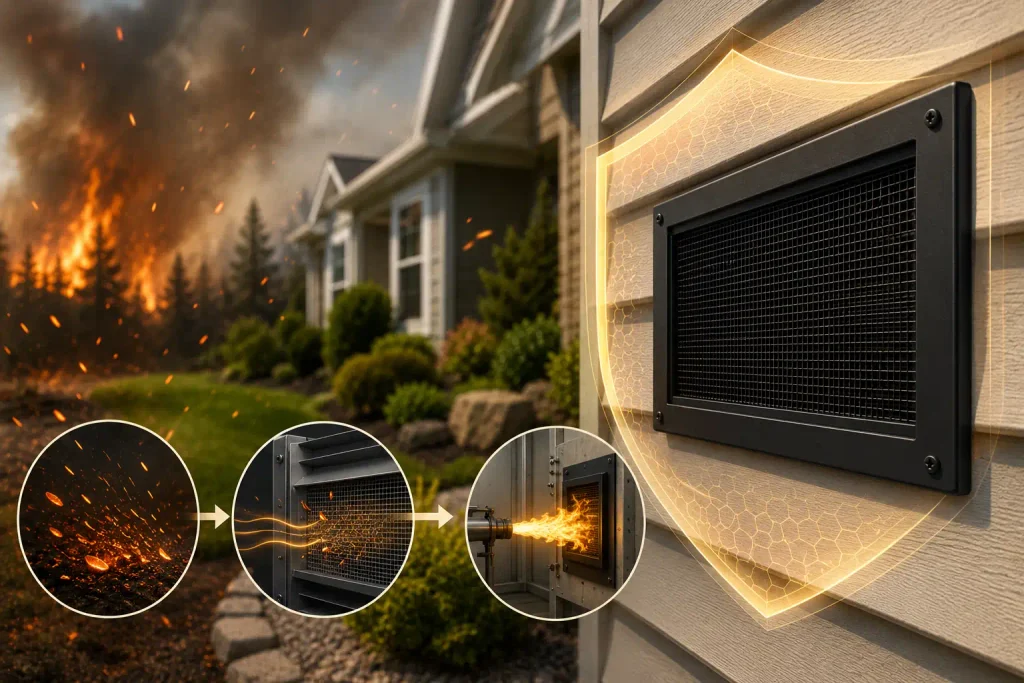
ASTM E2886 is a standardized test method published by ASTM International for evaluating the resistance of exterior vents to ember intrusion and flame penetration. It was developed specifically to assess how vent assemblies perform under conditions that simulate a wildfire event; not just general heat or fire resistance, but the specific combination of ember exposure and flame contact that occurs when a wildfire reaches a structure.
The standard is formally titled “Standard Test Method for Evaluating the Ability of Exterior Vents to Resist the Entry of Embers and Flame.” That title says exactly what it does: it tests whether a vent can keep embers and flame out.
Why ASTM Standards Matter
ASTM International develops and publishes voluntary consensus standards used across construction, manufacturing, materials science, and engineering. ASTM standards create a repeatable, third-party-verified evaluation framework, so when a manufacturer claims their product meets a standard, that claim can be independently confirmed.
For homeowners, this matters because wildfire vent marketing is full of language like “fire resistant,” “ember proof,” and “wildfire rated” that carries no standardized meaning on its own. ASTM E2886 provides the benchmark that cuts through that noise. A product either passes the test or it doesn’t—independent certification bodies verify the result.
The Purpose of ASTM E2886
The standard exists because vents are one of the most prolific ember entry points on a home, and until E2886 was developed, there was no standardized way to evaluate whether a vent actually blocked ember intrusion under realistic wildfire conditions. Mesh opening size alone—the old proxy measure—doesn’t tell you whether a vent will hold up when exposed to wind-driven embers and sustained heat. ASTM E2886 does.
How ASTM E2886 Vent Testing Works
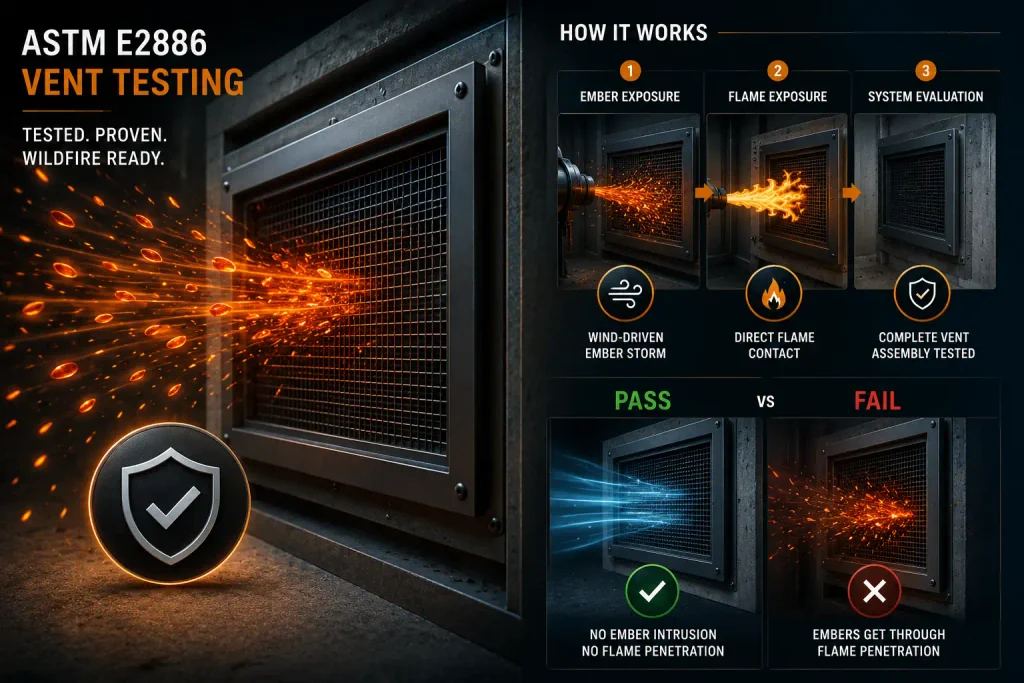
The standard tests complete vent assemblies, not just mesh samples, under conditions designed to replicate the ember-storm environment a home faces during an active wildfire.
Simulating Real-World Ember Exposure
The test apparatus generates a controlled stream of glowing embers directed at the vent assembly under specified wind pressure. This simulates the wind-driven ember bombardment that precedes and accompanies wildfire fronts; the same components responsible for up to 90% of structure losses in wildfire events. The assembly is evaluated while airflow is applied because a vent that only fails under static conditions may perform differently when it’s actively drawing air.
What the Test Evaluates
ASTM E2886 measures three things: ember penetration resistance, flame exposure response, and the mechanism’s behavior as a complete system under both conditions. The ember exposure phase assesses whether burning fragments can pass through the vent opening. The flame exposure phase evaluates how the assembly responds to direct flame contact—whether materials ignite, deform, or allow flame to pass through.
Most importantly, the standard tests the vent as a complete system, including the frame, mesh, internal components, and attachment method together, not just the screening material in isolation. A vent with appropriately sized mesh but a compromised frame, weak attachment, or poor fit can still fail. ASTM E2886 catches those system-level failures that material-only evaluations miss.
Understanding Pass and Fail Outcomes
A product that passes ASTM E2886 has demonstrated, under controlled and reproducible conditions, that it resists ember intrusion and flame penetration when installed as specified. A product that fails has not, regardless of what its marketing language may suggest.
Not all vents perform equally because not all vents are engineered equally. Mesh opening size, material composition, frame construction, and internal design all affect performance. The test result reflects the product as a whole system, which is why two products with similar-looking mesh can produce very different outcomes.
Why ASTM E2886 Matters for Homeowners
The Difference Between Tested and Untested Vent Systems
Most vents installed on existing homes, and many sold at hardware stores, have not been tested to ASTM E2886. Standard hardware cloth, galvanized screen, and fiberglass mesh are designed for pest exclusion and general airflow management, not wildfire exposure. They have no wildfire performance data because they’ve never been evaluated for it.
When a home faces ember attack, the difference between a tested and untested vent isn’t theoretical. An untested vent may physically block some embers under mild conditions while failing under the sustained pressure and heat of an actual fire event. A tested product has demonstrated performance under conditions that approximate what a real wildfire affects.
From a practical standpoint, tested products also give you something to document. Inspectors, insurance carriers, and building departments can verify ASTM E2886 listings against published certification directories. Untested products have no listing to produce, which creates problems at exactly the moments when that documentation matters most.
How Certification Supports Home Hardening
Ember-resistant vents that carry ASTM E2886 certification are independently verified by third-party testing organizations, not self-certified by manufacturers. Firestorm EmberVent™ and EmberMesh™, for example, are listed through QAI (Listing #B1155) and carry ratings to ASTM E2886, ASTM E84 (surface burning characteristics), and ASTM E2768 (extended ignition resistance). That stack of third-party verification means the performance claims are documentable.
For homeowners in wildfire-prone areas, this certification underpins an informed purchasing decision—you’re buying a product whose performance has been verified under conditions relevant to the actual threat.
ASTM E2886, Listed Vents, and Chapter 7A Requirements
What Are Listed Vents?
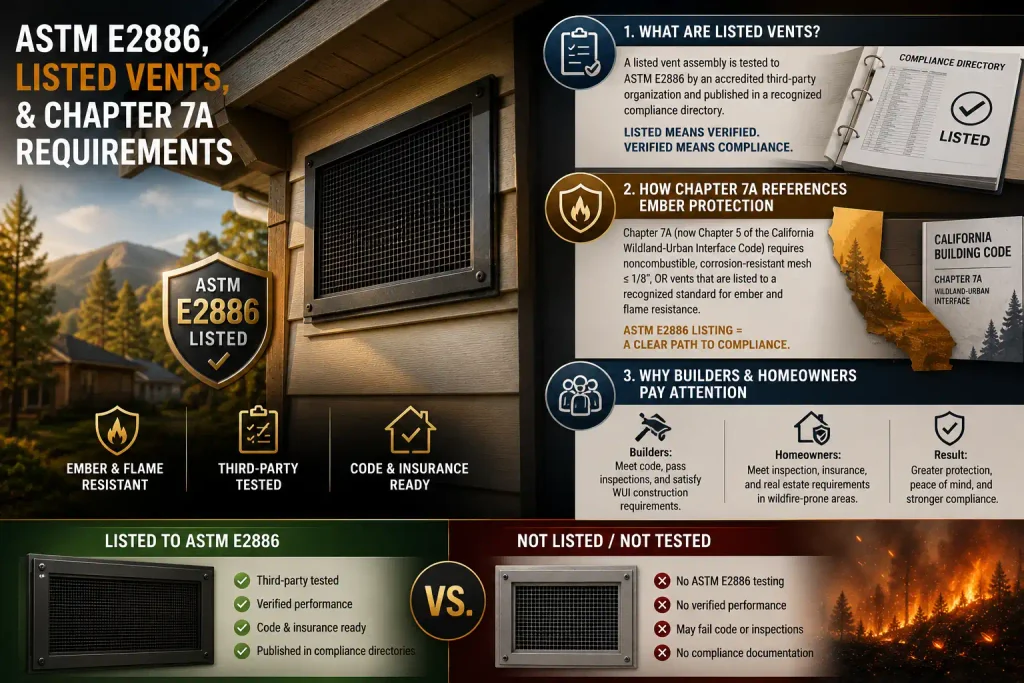
A listed vent is a vent assembly that has been tested to ASTM E2886 by an accredited third-party organization and published in a recognized compliance directory. “Listed” is a specific term in building and fire code that means the product appears in a directory maintained by an accredited listing organization, tied to the specific test results that earned the listing.
This matters because this distinction creates a verifiable paper trail. When a contractor, inspector, or building department asks whether a vent is code-compliant, a listed product can be confirmed against a published directory. An unlisted product, however well-intentioned its installation, cannot.
How Chapter 7A References Ember Protection
California’s Chapter 7A (now Chapter 5 of the California Wildland-Urban Interface Code) establishes construction requirements for homes in High and Very High Fire Hazard Severity Zones. For vents, the code requires noncombustible, corrosion-resistant mesh with openings no larger than 1/8″, or vents that are listed to a recognized standard for ember and flame resistance.
That “or listed” path is where ASTM E2886 becomes a compliance mechanism. A vent tested and listed to ASTM E2886 satisfies Chapter 7A’s vent requirements as a listed assembly—a cleaner compliance path than trying to demonstrate that a particular mesh material meets prescriptive specifications. For a detailed breakdown of how listed vents compare to prescriptive mesh compliance under specific state codes, our wildfire vent requirements guide clearly explains the differences.
Why Builders and Homeowners Pay Attention to These Standards
ASTM E2886 listing are increasingly showing up as a requirement in new construction specifications, insurance underwriting criteria, and inspection checklists for WUI-zone properties. It’s no longer just a voluntary quality marker. It’s becoming the baseline expectation in markets where wildfire risk is driving regulatory and insurance scrutiny.
Builders specifying products for WUI construction need ASTM E2886-listed vents to satisfy code and pass inspection. Homeowners retrofitting existing homes need them to satisfy inspection requirements triggered by AB 38 real estate transactions, insurance reviews, or community-wide hardening programs.
ASTM E2886 vs. Standard Vent Screens
Limitations of Standard Vent Screens
Standard vent screens—hardware cloth, fiberglass mesh, galvanized screen—are not designed for wildfire exposure and have not been evaluated under ASTM E2886. Therefore, failure modes are predictable:
- Mesh opening size alone doesn’t determine ember resistance. Two products with identical 1/8″ openings can perform very differently under ember exposure depending on material composition, frame construction, and installation quality. ASTM E2886 captures that variability; mesh size alone does not.
- Material degradation under heat eliminates protection when it’s needed most. Fiberglass screening melts. Plain galvanized steel can warp and corrode under sustained heat exposure. Neither material failure is captured by a mesh-size specification.
No testing means no documentation. Without an ASTM E2886 listing, there’s no certification to present to an inspector, no listing number to verify, and no third-party data to support compliance claims.
Advantages of Tested Ember-Resistant Vent Systems
ASTM E2886-tested vents provide verified performance, documentable compliance, and system-level evaluation that material-only approaches can’t match. For the full inspection-specific comparison of what happens when these two approaches meet an inspector, Firestorm’s EmberMesh vs. standard mesh inspection guide covers exactly where standard mesh fails and why.
| Feature | Standard Vent Screen | ASTM E2886-Tested Vent |
|---|---|---|
| Ember Testing | Not tested for ember intrusion | Independently tested under ember storm conditions |
| Wildfire Performance | No verified data | Evaluated under simulated wildfire exposure |
| Compliance Support | No listing; cannot satisfy code | Listed assembly; satisfies Chapter 7A / WUI code |
| Performance Verification | Manufacturer claim only | Third-party certified, verifiable in listing directories |
| Home Hardening Benefits | Fills the opening; provides no documented protection | Documented protection with verifiable credentials |
How ASTM E2886 Fits Into a Complete Wildfire Defense Strategy
Vent Protection Is Only One Layer
ASTM E2886-listed vents address the primary ember entry point, but embers probe every vulnerable surface on a home, not just the designed ventilation openings.
A complete wildfire defense strategy addresses the building envelope systematically:
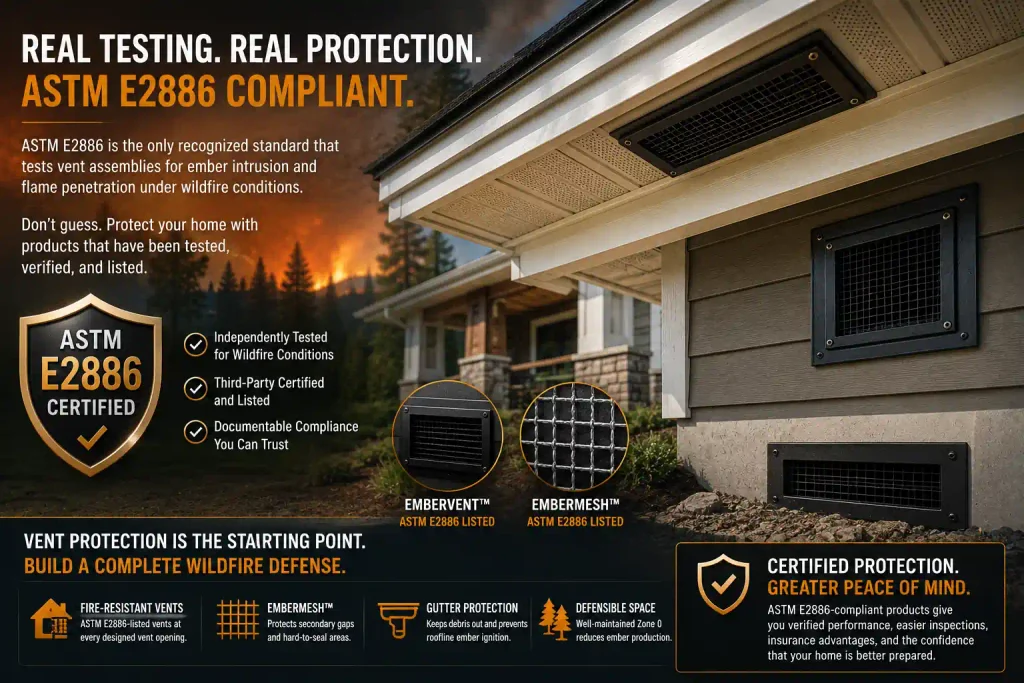
- Fire-resistant vents at every designed vent opening, eave, soffit, gable, dormer, foundation, with ASTM-listed performance
- EmberMesh™ for secondary gaps: deck skirting, crawlspace perimeters, and openings that standard vents don’t address
- Gutter protection to eliminate roofline debris accumulation, one of the most common external ember ignition sites
- Defensible space and Zone 0 management that reduces ember production near the structure
For state-specific compliance context beyond California, Firestorm’s Colorado wildfire ventilation compliance guide covers how ASTM E2886 fits into that regulatory framework.
Building a More Resilient Home
ASTM E2886 certification in a home hardening strategy turns a vulnerability into a strength that can be documented. Every ASTM-listed vent installed and recorded is evidence of proactive mitigation—useful for insurance conversations, inspection readiness, and the peace of mind that the protection you’ve installed has been verified to perform when it matters.
Common Misconceptions About ASTM E2886
Does ASTM E2886 Guarantee a Home Will Never Burn?
ASTM E2886 certification means a vent has been tested to resist ember entry and flame penetration under standardized conditions, but it doesn’t guarantee a home will survive any wildfire under any circumstances. Wildfire intensity, duration, proximity, and site-specific conditions all affect outcomes in ways no single product can control.
What ASTM E2886 certification does guarantee is that the vent has been evaluated under conditions designed to be relevant to real wildfire exposure and that its performance has been third-party verified. That’s meaningful, but not absolute protection, and the distinction matters because no responsible home hardening strategy rests on a single product.
Does Every Vent on the Market Meet ASTM E2886?
This is the most important misconception to correct. Most vent products sold at hardware stores and used in general construction have not been tested to ASTM E2886. Metal mesh, a reasonable opening size, or “fire resistant” language in product marketing does not indicate ASTM E2886 compliance. To verify compliance, look for an explicit ASTM E2886 listing with a third-party certification number, not a manufacturer’s self-description. When in doubt, ask for the listing documentation—a legitimately certified product has a number you can verify.
Protecting Your Home with ASTM E2886-Compliant Products
ASTM E2886 is the standard that answers the question every homeowner in a fire-prone area should be asking about their vents: has this product actually been tested to stop embers and withstand flame under wildfire conditions?
For most vents currently installed on existing homes, the truth is that they haven’t been, but the good news is that that’s an addressable problem. Choosing ASTM E2886-listed vents means choosing products whose performance has been independently verified, whose compliance can be documented, and whose engineering was designed for the conditions they’ll face.
Vent protection is the starting point, not the complete solution, but it’s a great place to start—with products that have earned the certification rather than just claimed it. Firestorm’s ember-resistant vents and EmberMesh™ carry ASTM E2886 certification with third-party verification. If you’re evaluating your home’s current vent protection, that’s the baseline to measure against.

