

Wildfire home hardening works. The evidence from the 2025 Los Angeles fires, where hardened homes survived in neighborhoods that otherwise burned, is as clear as any the state has produced. The problem has always been cost: fire-safe roofs, Zone Zero landscaping, and comprehensive vent upgrades represent real money that many homeowners in high-risk areas don’t have.
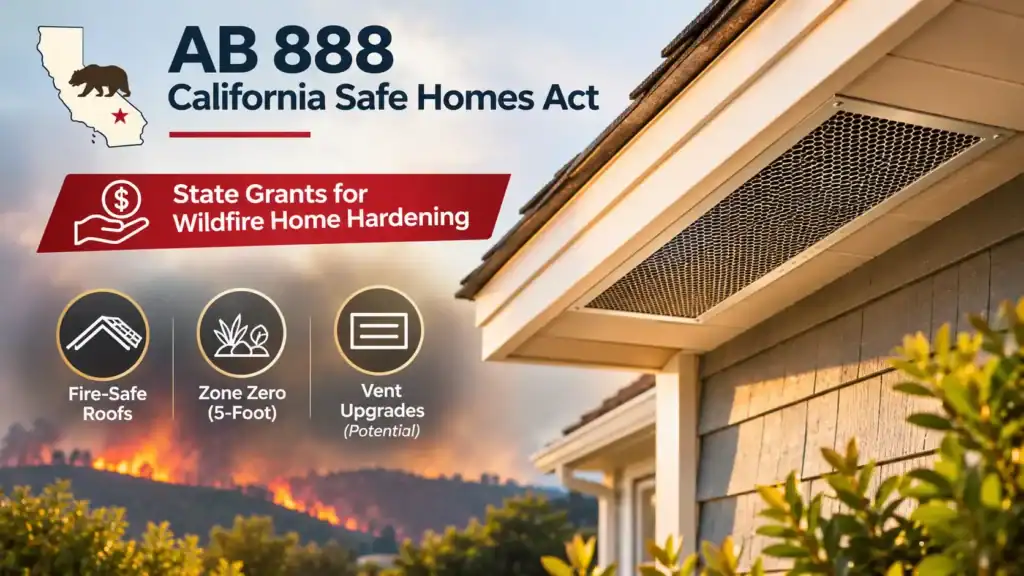
California’s AB 888, the California Safe Homes Act, is designed to change that math. Signed by Governor Newsom on October 10, 2025, and effective January 1, 2026, the law establishes a new state grant program administered by the California Department of Insurance (CDI) to help low- and middle-income homeowners pay for wildfire mitigation improvements. Here’s what the law covers, where ember-resistant vent upgrades fit in, and what homeowners should do now to position themselves for funding when applications open.
What Is the AB 888 California Safe Homes Act?
AB 888 establishes the California Safe Homes grant program within the CDI, funded through a new Sustainable Insurance Account. The program has three stated goals: reducing local and statewide wildfire losses, improving community resilience, and supporting home hardening that can help homeowners qualify for private market insurance rather than relying on the FAIR Plan.
What the California Safe Homes Grant Program Does
The program is open to individual homeowners who meet income eligibility requirements, specifically, applicants whose income does not exceed the low-income limit for their county and whose property is located in a zip code that overlaps with a High or Very High Fire Hazard Severity Zone. Grants are also available to qualifying cities, counties, and special districts for community-level wildfire mitigation projects.
As of this writing, CDI has not yet opened the application portal. The department indicated it was targeting a spring 2026 launch—confirm current status and application details directly at the California Department of Insurance’s AB 888 program page before taking any action based on this article.
What Projects Receive Priority?
The enacted law establishes specific grant priorities. The two confirmed categories are:
- Fire-Safe Roof Replacement: Replacing an existing roof with a fire-resistant roofing system is the program’s primary documented focus. This reflects a direct legislative response to the scale of roof-related losses in recent California fires.
- Five-Foot Noncombustible Zone Zero: Clearing combustible materials, such as mulch, bark, vegetation, and stored items, from the immediate five-foot perimeter surrounding the structure and replacing them with noncombustible alternatives (gravel, decomposed granite, stone) is the second confirmed priority.
- Community-Wide Wildfire Mitigation Projects: Cities, counties, and special districts can apply for grants to fund broader mitigation programs across neighborhoods and communities.
The statute does not specify grant amounts. CDI has authority to set funding levels based on legislative appropriations.
Can AB 888 Grants Pay for Ember-Resistant Vent Upgrades?
What the Law Currently Covers
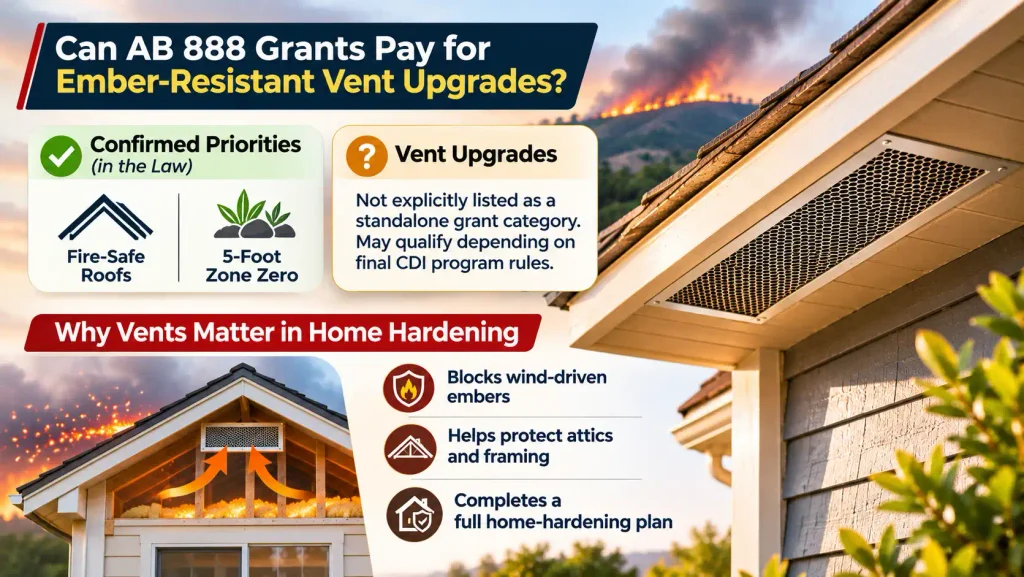
This is the question the H1 raises, and it deserves a direct answer: the enacted law’s documented funding priorities are fire-safe roofs and Zone Zero. Ember-resistant vent replacement is not explicitly listed as a standalone grant category in AB 888 as signed.
That said, vent protection appears in the legislative background and committee analysis as part of the broader wildfire mitigation context; the Assembly Insurance Committee documentation specifically references ember- and fire-resistant vents with 1/16″ to 1/8″ noncombustible mesh as a relevant home hardening measure. Whether CDI will include vents as an eligible standalone expense, as part of a comprehensive home hardening package, or alongside a prioritized roof or Zone Zero project is a program implementation detail that hasn’t been finalized.
The honest answer: vents may qualify depending on how CDI defines eligible expenses in the program rules. Homeowners should watch for program updates and confirm eligibility directly with CDI when applications open, rather than assume vents are included or excluded based on pre-launch reporting.
Where Vents Fit Into Home Hardening
Attic vents, eave vents, soffit vents, and foundation vents are all open by design, and during a wildfire, they’re openings that wind-driven embers probe under sustained pressure. Research consistently identifies vent intrusion as one of the most common pathways through which embers reach interior combustible materials: attic insulation, wood framing, and accumulated debris that ignites in enclosed spaces, out of sight, before it becomes visible from the exterior.
A grant program that funds roofs and Zone Zero without addressing vents closes two significant vulnerabilities while leaving a third open. Whether or not AB 888 directly funds vent upgrades, including them in a comprehensive home hardening plan reflects what the research on wildfire home survivability actually shows.
How Ember-Resistant Vents Support a Wildfire-Ready Home
Why Standard Vent Screens Can Be Vulnerable
Standard insect screens and hardware cloth—the mesh on most existing vents—were designed for pest exclusion, not wildfire protection. Common 1/4″ and 1/8″ openings allow many ember-sized fragments through. Fiberglass and plastic mesh components melt under radiant heat. And none of these materials have been tested under ASTM E2886, the standard that evaluates complete vent assemblies for ember entry and flame penetration resistance under simulated wildfire conditions.
The distinction matters because a vent that looks protected isn’t necessarily protected for wildfire exposure. “Fire resistant” language on a product label has no standardized meaning without third-party testing documentation.
What to Look for in a Wildfire-Resistant Vent
When evaluating ember-resistant vent upgrades, whether in the context of an AB 888 grant project or as standalone home hardening, look for:
- Noncombustible metal mesh with openings of 1/16″ or finer, the IBHS Wildfire Prepared Home standard, or 1/8″ maximum per California Chapter 5 WUI code
- ASTM E2886 listing by an accredited third-party certification body; this confirms the complete vent assembly, not just the mesh material, has been evaluated under simulated wildfire conditions
- Adequate net free vent area (NFVA) to maintain the attic ventilation the home requires; ember protection shouldn’t compromise ventilation performance
- Appropriate materials for the installation environment: stainless steel, copper, or powder-coated options for coastal installations within 5 miles of the ocean, where salt air accelerates galvanized steel corrosion
How to Prepare for California Wildfire Grant Opportunities
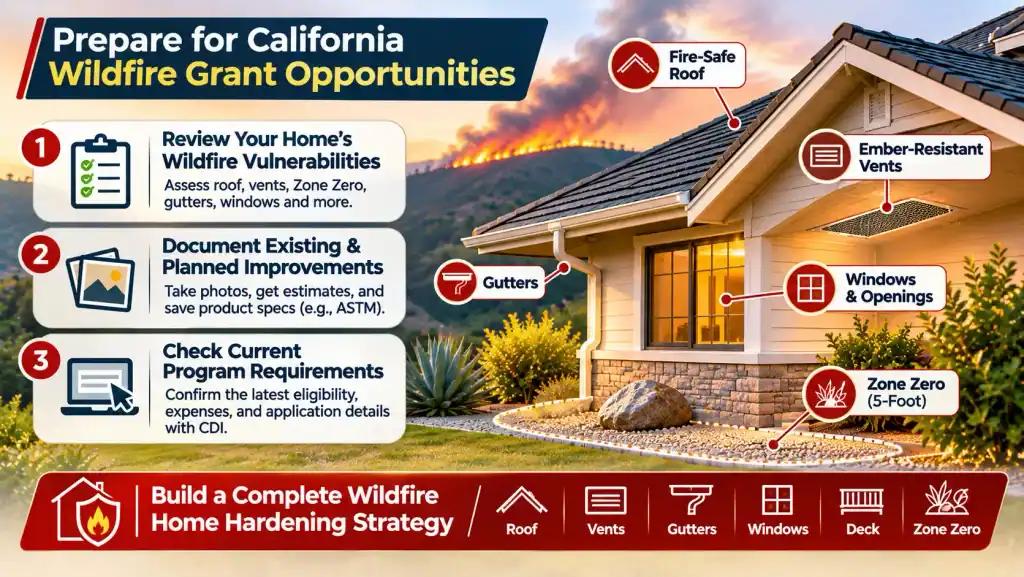
The application process isn’t open yet, which means there’s time to get organized before funding becomes available.
Review Your Home’s Wildfire Vulnerabilities
Work through the full building envelope systematically: roof condition and material, Zone Zero clearance, vent screening at all locations (attic, eave, soffit, gable, foundation), gutters, deck perimeter, windows, and building-envelope gaps. Firestorm’s Wildfire Home Hardening Checklist provides a structured walkthrough of every location. A vulnerability assessment now gives you a documented baseline and helps you identify which improvements align with AB 888 priorities.
Document Existing and Planned Improvements
CDI has indicated that grant recipients will need to provide written attestation of completed work, along with documentation showing whether they qualified for wildfire incentives from their insurance company after using grant funds. Start building that documentation now: take photographs of existing conditions at the roof, vents, and Zone Zero perimeter. Get estimates for priority improvements. Save product specification sheets, including ASTM listing information for any vent products you’re considering. The law requires documentation that demonstrates insurance impact; the more organized your records, the smoother the application process will be.
Check Current California Program Requirements
Program details are still being finalized by CDI. Eligible expenses, income thresholds, grant amounts, and the application process may differ from what early reporting has described. Before making purchasing or contracting decisions based on expected grant reimbursement, verify current requirements directly with the California Department of Insurance. Do not rely on this article or any other third-party summary as the definitive source for program eligibility, as program rules can change between legislation and implementation.
Build a Complete Wildfire Home Hardening Strategy
The Full Picture
AB 888 focuses on the improvements with the highest per-dollar wildfire loss reduction: roofs and Zone Zero. Both are critical, but they’re not the total picture. A home with a Class A roof and cleared Zone Zero that still has standard hardware cloth on its attic and foundation vents has closed two vulnerabilities while leaving a third open.
Effective wildfire home hardening addresses the building envelope as a system: roof, vents, eaves, gutters, windows, deck perimeter, Zone Zero, and defensible space beyond it. Each layer addresses a different category of ember exposure. Each one matters independently, and collectively they produce the kind of documented mitigation that influences insurance outcomes, which is exactly what AB 888 is designed to reward.
V2™ Vents are one potential component of that broader strategy, engineered for the specific conditions that standard vent screening was never designed to handle, with two-stage passive and active protection tested to ASTM E2886/E2886M/E2912. How V2™ Vents Work covers the mechanism in full. Firestorm’s fire-resistant vents resource covers the broader range of options across all vent locations.
Whether or not AB 888 grants ultimately cover vent upgrades, the case for including them in a comprehensive home hardening plan doesn’t depend on the grant program. It depends on what the research shows about how homes burn, and vents are consistently in that picture.
____________________________________________
This article is for educational purposes only and does not constitute legal, financial, or insurance advice. AB 888 program details, eligibility criteria, and application requirements are subject to change during CDI implementation. Verify current program information directly with the California Department of Insurance before making decisions based on expected grant funding.

