

Wildfire risk is no longer a regional footnote. It’s reshaping how homeowners across 14 states think about property resilience, insurance, and long-term investment in their homes. As insurers tighten underwriting standards and regulators push for documented mitigation, a growing number of homeowners are looking for a credible, structured way to decrease their home’s vulnerability to wildfires.
The IBHS Wildfire Prepared Home™ program provides exactly that. Developed by the Insurance Institute for Business & Home Safety and grounded in post-fire forensic research, it gives homeowners a science-based path to reduce ignition risk and the documentation to prove it. Our guide explains what the certification is, what it requires, and how the home hardening improvements needed to qualify connect to practical upgrades most homeowners can implement.
What Is Wildfire Prepared Home Certification?
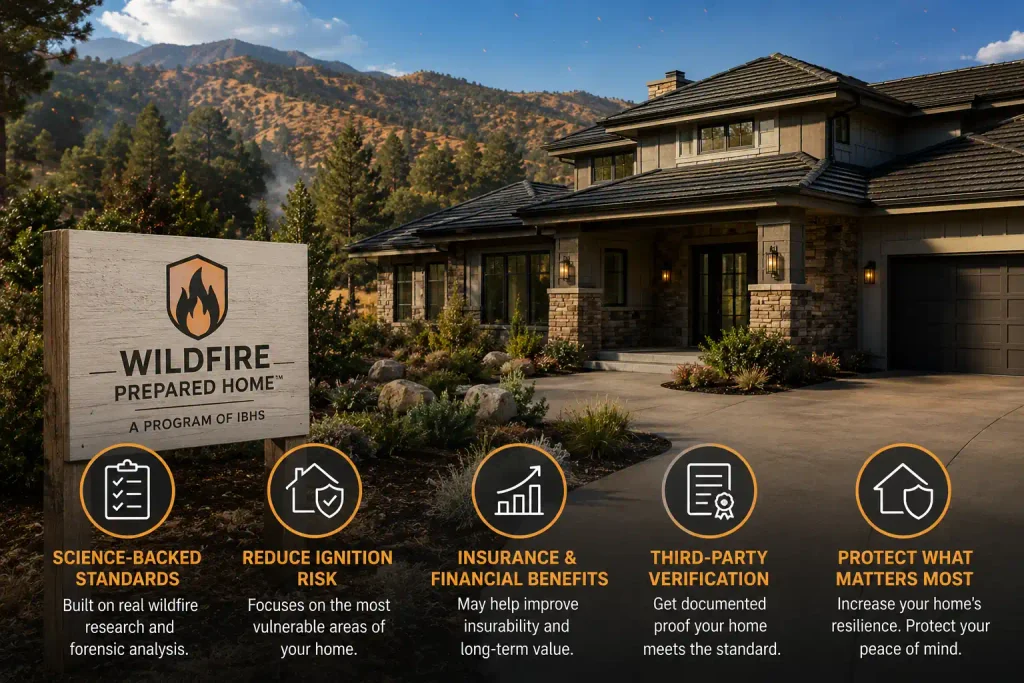
Wildfire Prepared Home™ is a voluntary, research-based mitigation and designation program developed by IBHS. It gives homeowners a proven, systematic path to reduce their home’s wildfire risk and demonstrate that work to insurers, lenders, and communities.
The program offers two designation levels: Essential, which is focused on reducing risk from wind-driven embers, and Enhanced, which provides additional protection from radiant heat and direct flame contact. Most existing homes can be retrofitted to achieve the Essential designation. Enhanced requires more significant structural upgrades and is better suited to new construction or major remodels.
The Role of IBHS in Wildfire Research
IBHS is an independent, nonprofit research organization funded by the insurance industry. Its wildfire research focuses on the structural and site-level factors that determine whether a home survives a wildfire event—not only proximity to fire, but how specific features perform under ember attack, radiant heat, and direct flame contact. The Wildfire Prepared Home standard is built on that research, including forensic analysis of major fire events.
Why the Program Was Created
IBHS modeled the standard on post-fire forensic data from the Camp Fire (Paradise, 2018), the Tubbs Fire (Santa Rosa, 2017), and the 2025 Palisades and Eaton fires. In those events, the vast majority of structures did not burn from direct flame contact. They burned because wind-driven embers landed in roof valleys, attic vents, and in gutters full of pine needles or other combustible materials stacked against the foundation. The program was created to address those specific, preventable failure points with measurable standards.
Why Certification Matters for Homeowners
Improving Wildfire Resilience
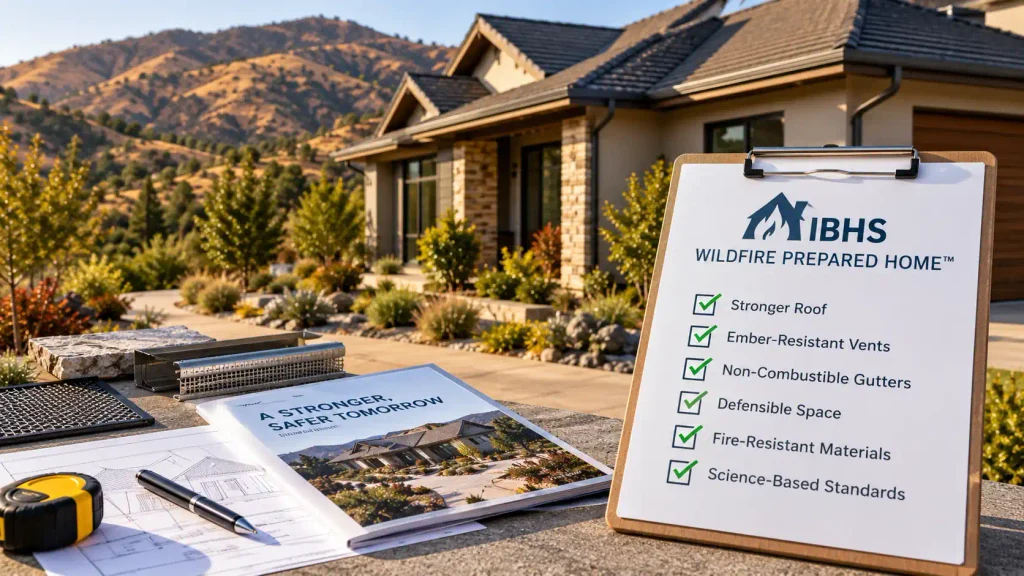
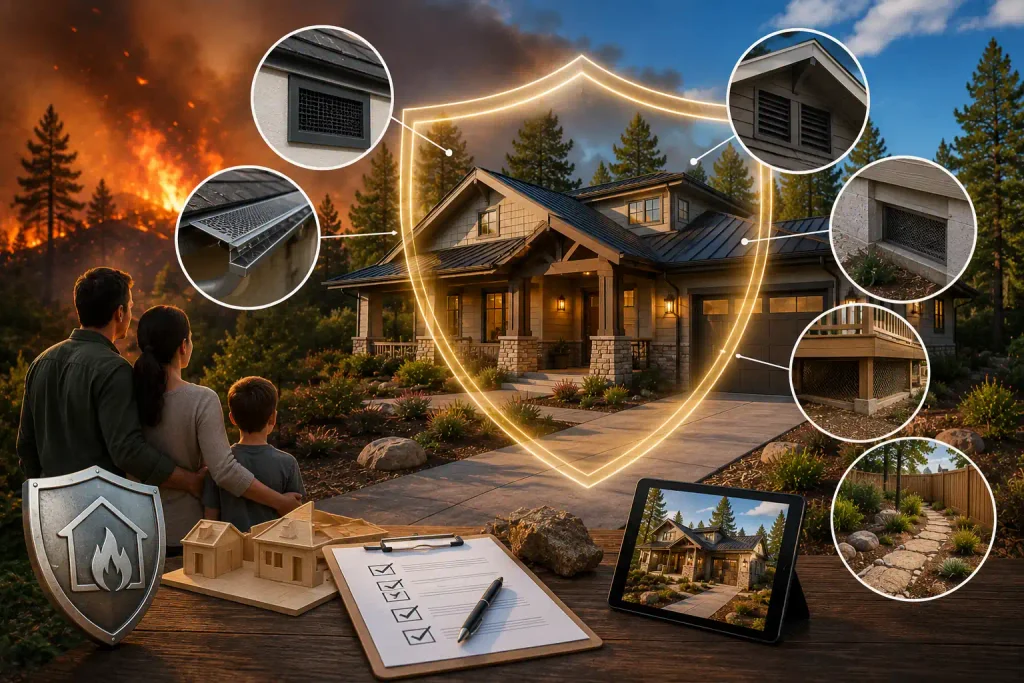
The most direct benefit of pursuing certification is structural: the upgrades required to qualify actually reduce the ignition pathways that cause most home losses. Ember-resistant vents, noncombustible Zone 0 clearance, debris-free gutters, and protected openings address the documented instruments of home ignition beyond general fire preparedness.
Demonstrating a Commitment to Risk Reduction
To receive a designation, homeowners must complete all required mitigation actions in the standard. The requirements go beyond guidance from most local jurisdictions and reflect the latest IBHS wildfire research. That completeness is what makes the certification meaningful as documentation because it represents a verified, comprehensive assessment, not a self-reported checklist.
Supporting Insurance and Property Value Discussions
Under AB 2167 (2020) and its 2026 implementing regulations, California insurers must factor fire-hardening into rates. In practice, discounts range from 5–35% depending on the carrier, with USAA, Farmers, and Mercury among those offering documented credits to designated homes. In markets where wildfire exposure is driving non-renewal, documented hardening can reduce the risk of losing coverage altogether. The designation certificate is also transferable at sale, which carries marketability value in fire-prone communities.
How to Qualify for Wildfire Prepared Home Certification
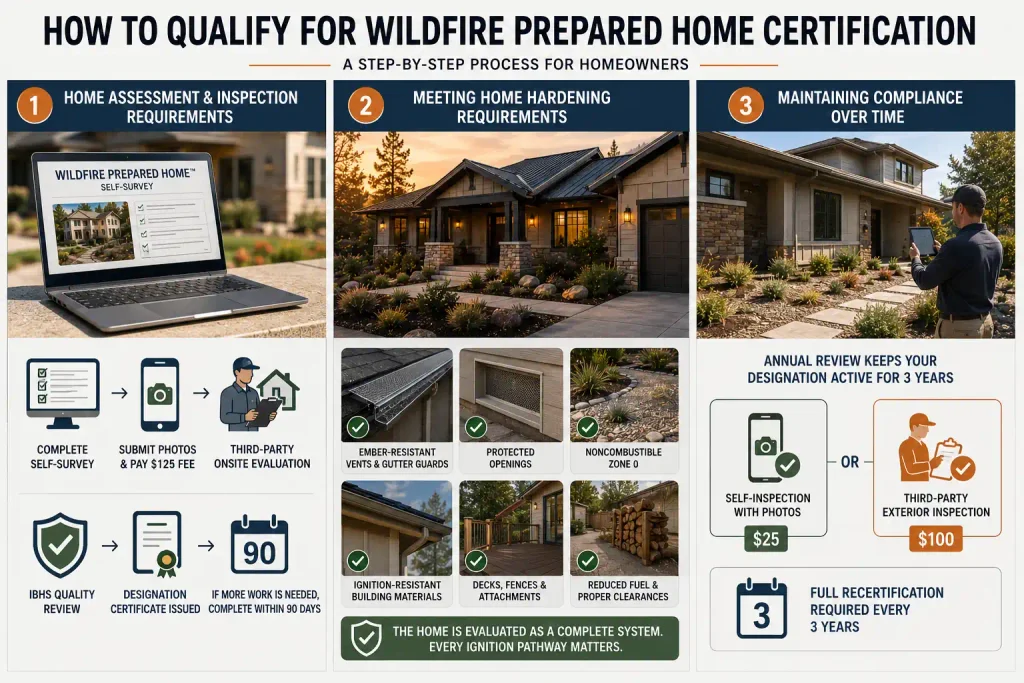
The process begins with a self-survey, followed by photo submission and a $125 nonrefundable application fee.
Home Assessment and Inspection Requirements
IBHS reviews the photos to confirm required work is complete, then a third-party in-person evaluator visits the home to document completed work. IBHS conducts a final quality review and issues a designation certificate if all requirements are met. If additional work is needed, homeowners have 90 days to complete it and resubmit.
Meeting Home Hardening Requirements
The certification evaluates the home as a complete system. Every ignition pathway matters, and every required mitigation measure must be completed. Partial compliance doesn’t count. The upgrades required are specific and verifiable, which is what makes the standard useful: there’s no ambiguity about what qualifies.
Maintaining Compliance Over Time
Once a designation is achieved, homeowners must take an active role in maintaining the three-year designation by submitting an annual review that verifies ongoing landscaping maintenance, so the property continues to comply with program requirements. Two options are available: a self-inspection with photos for $25, or a third-party exterior inspection for $100. Full recertification is required every three years.
Common Home Hardening Improvements Required for Certification
Ember-Resistant Vent Protection
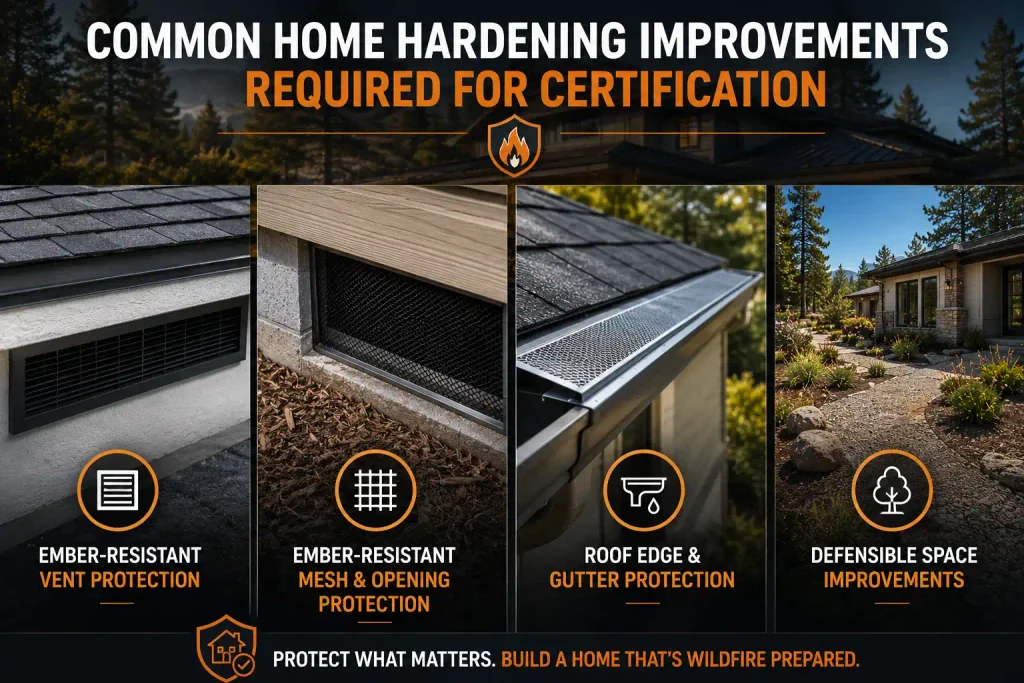
Vents are the most common ember entry point on a home, and the Wildfire Prepared Home standard addresses them specifically. All vents—foundation, gable, soffit, ridge—must be covered with mesh or vents that pass ASTM E2886 testing. This means every ventilation opening on the structure, not just the visible ones. EmberVent™ ember-resistant vents are tested and listed to ASTM E2886, E2768, and E84, satisfying this requirement across all vent types and locations.
Ember-Resistant Mesh and Opening Protection
Beyond designed vent openings, secondary gaps, including under deck skirting, crawlspace perimeters, around utility penetrations, and at fence connections, also require protection under the standard. EmberMesh™ addresses these secondary vulnerabilities with the same ASTM-tested stainless steel mesh used in listed vent assemblies, available in widths suited to retrofit applications across irregular openings.
Roof Edge and Gutter Protection
Debris accumulation in gutters creates a ready fuel bed at the roofline—one of the most common external ember ignition sites documented in post-fire assessments. The standard requires gutters to be clear of combustible debris, and FireStorm® Gutter Guards prevent that accumulation from developing between cleanings. Metal mesh gutter protection eliminates the roofline fuel bed that turns an ember landing into a structural ignition as much as it also reduces the need for regular cleaning maintenance.
Defensible Space Improvements
The standard requires a noncombustible Zone 0 is a five-foot ember-resistant perimeter immediately surrounding the structure with no combustible materials, mulch, vegetation, or stored items. The standard aligns with California’s defensible space zones for vegetation management and fuel reduction. California wildfire home hardening and defensible space covers the specific zone requirements and what qualifies as compliant in each.
Certification and the Wildfire Defense System Approach
Why Single Upgrades Are Not Enough
The Wildfire Prepared Home standard is explicitly systems-based, requiring homeowners to complete all required mitigation actions, and reflecting how homes actually ignite: embers probe the entire structure simultaneously, and an unaddressed vulnerability remains an ignition point, regardless of what else has been upgraded.
Building a Complete Wildfire Defense Strategy
The upgrades required for certification map directly onto what wildfire researchers identify as the primary ignition pathways: vent entry, secondary gap penetration, roofline fuel ignition, and combustible materials adjacent to the structure. Addressing all of them through a complete wildfire defense system approach rather than isolated product choices is what the standard requires and what the research supports.
Preparing Your Home for Certification
Start With a Home Hardening Checklist
Before starting the formal IBHS application process, a systematic vulnerability assessment identifies which upgrades are needed and in what sequence. Firestorm’s wildfire home hardening checklist provides a structured walkthrough of every location—vent by vent, gap by gap, roofline to foundation—that maps directly to the kinds of improvements this certification evaluates. For the full integrated upgrade strategy, our ultimate home wildfire protection guide covers assessment and implementation in detail.
Engage Community Preparedness Efforts
Individual home certification strengthens a community’s collective resilience, and community-level programs reinforce individual action. NFPA’s Firewise Communities recognition provides a neighborhood-level framework that complements the home-level Wildfire Prepared designation. IBHS has also introduced formal standards for neighborhoods and multifamily properties, extending the program’s science-based approach beyond individual homes to address wildfire risk at the building and neighborhood levels.
Common Misconceptions About Wildfire Prepared Home Certification
Certification Does Not Eliminate Wildfire Risk
No one designation, certification, or product guarantees that a home will survive any wildfire under any conditions. Wildfire intensity, wind behavior, site topography, and fire duration all affect outcomes in ways that structural hardening cannot fully control. Certification reduces the probability of ignition from the most common causes of home losses—ember intrusion and combustible material near the home—in a verified, documented way.
Certification Is More Than Defensible Space Alone
Many homeowners equate wildfire preparedness with vegetation clearance. Defensible space is one component of the standard, but the Wildfire Prepared Home designation also requires ember-resistant vent protection at every opening, gutter debris management, protection of secondary gaps and openings, in addition to noncombustible Zone 0 clearance. A home with excellent defensible space and unprotected standard vents does not qualify.
Ensuring You Have a Wildfire Prepared Home
IBHS Wildfire Prepared Home certification gives homeowners in wildfire-prone communities a structured, research-backed path to reduce ignition risk and to document that work in a way that matters to insurers, lenders, and communities. The requirements are specific, the process is transparent, and the underlying science is grounded in forensic analysis of real fire events.
Qualifying requires a genuine commitment to comprehensive mitigation: ember-resistant vents at every opening, protected secondary gaps, debris-free gutters, Zone 0 clearance, and ongoing vegetation management. None of these are cosmetic improvements. They’re specific upgrades that post-fire research identifies as the difference between homes that survive wildfires and homes that don’t.
If you’re evaluating whether your home could qualify, start with a systematic vulnerability assessment before the application. What you find tells you exactly where to focus, and how far you are from a home that’s genuinely prepared.

