

When wildfires approach, most homeowners picture a wall of flame bearing down on their house. The reality is that most homes ignite less dramatically and are more preventable.
Research from IBHS shows that up to 90% of homes lost in wildfires are ignited not by direct flame contact, but by wind-driven embers that travel miles ahead of the fire front. Those embers land on rooftops, collect in gutters, and slip through gaps in the building envelope. The most common point of entry? Vents.
Standard attic, soffit, and crawl space vents are designed to move air. During a wildfire, they move embers just as efficiently. Fire resistant vents are engineered to stop that from happening—maintaining ventilation without exposing your home’s interior to ignition. Our guide will explain how they work, where vulnerability lives, and how to build a complete defense system around them.
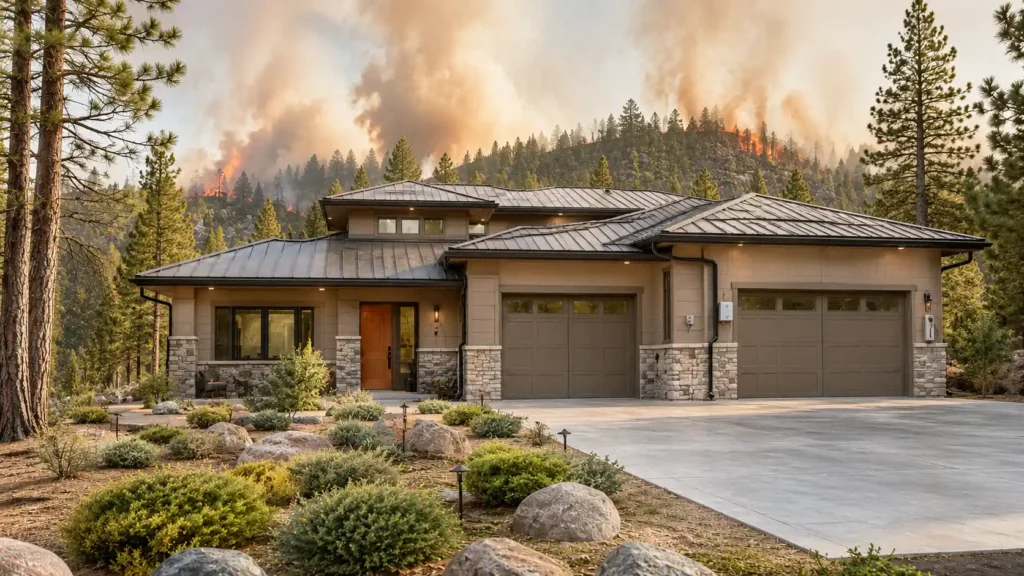
Where Embers Get In: Your Home’s Vulnerable Entry Points
Not all vents carry equal risk, but they all share the same fundamental problem: they’re open by design. Understanding where ember intrusion is most likely helps you prioritize upgrades.
Eaves and Soffits
Under-eave and soffit vents are particularly dangerous because they’re positioned directly in the path of wind-driven embers sweeping horizontally across a structure. Embers pile up against eave surfaces and find open mesh quickly. Chapter 7A specifically prohibits the use of standard eave vents in WUI zones unless they are proven to resist both ember and flame intrusion.
Attic and Gable Vents
Gable vents, dormer vents, and roof vents create direct pathways into attic spaces. Once a burning ember reaches attic insulation or framing, a fire can develop inside the structure while the exterior appears undamaged, leaving little time for intervention.
Crawl Spaces and Foundations
Low-level foundation vents draw in embers from ground-level accumulation, particularly where debris has built up near the perimeter. These vents are easy to overlook during home hardening planning, but represent a real ignition pathway.
For a deeper look at exactly how embers exploit these vulnerabilities, Firestorm’s guide to how embers ignite homes covers the science in detail.
Standard Vents vs. Fire Resistant Vents: What’s the Difference?
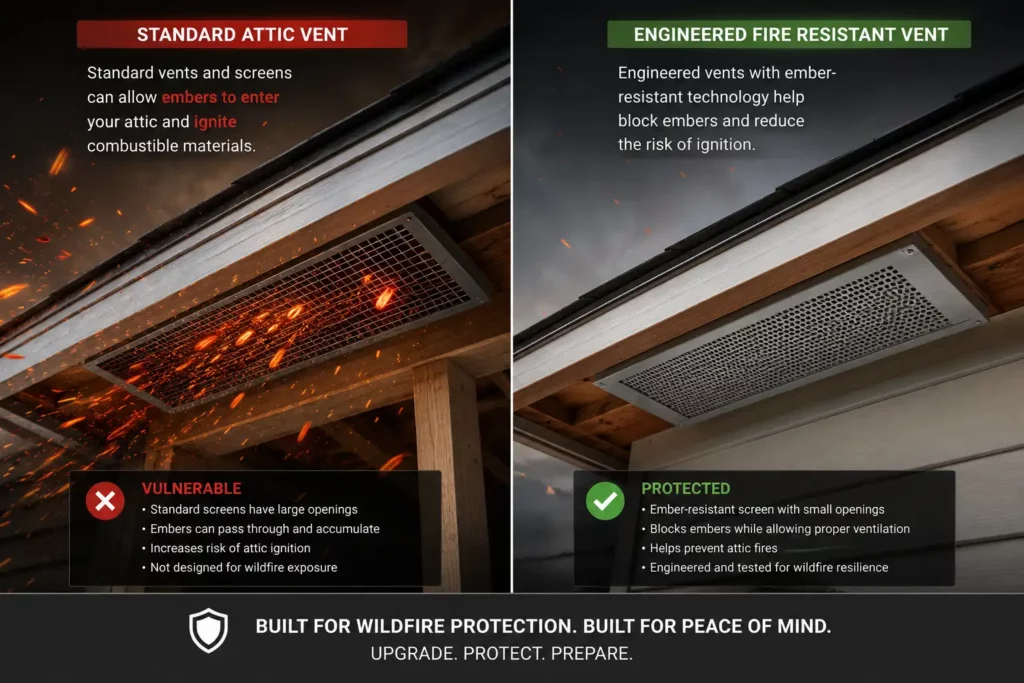
Standard vents are designed for one job: airflow. They are not engineered for wildfire conditions, and most fail to stop ember intrusion for a simple reason: their mesh openings are too large.
Common 1/4″ mesh screens, which are standard on many existing homes, allow embers to pass through freely. Fiberglass and plastic mesh compound the problem: these materials can melt or ignite when exposed to heat, eliminating protection at exactly the moment it matters most.
EmberVent™ fire-resistant vents are built around a different design philosophy entirely. They combine fine-gauge, noncombustible metal mesh with engineered baffle systems and high-temperature materials that block ember intrusion and reflect radiant heat. EmberVent™ is rated to ASTM E-84, ASTM E-2768, and ASTM E-2886: the test standards that California, Oregon, Washington, Colorado, and Texas recognize for WUI compliance.
Critically, engineered fire-resistant vents accomplish this without sacrificing the ventilation your attic requires. Restricting airflow creates its own problems: moisture buildup, condensation, mold, and wood rot. The goal is not to seal vents, but to filter them.
The Mesh Standard That Matters: 1/16″
Mesh size is the most important technical variable in fire resistant vent performance. The opening size determines whether a burning ember can physically pass through.
Chapter 7A—California’s building code standard for WUI construction—requires noncombustible mesh with openings no larger than 1/8″. The IBHS Wildfire Prepared Home standard takes it further, requiring mesh openings of 1/16″ or vents listed to ASTM E2886. That tighter standard blocks a significantly broader range of ember sizes.
What disqualifies a vent immediately: any mesh larger than 1/8″, fiberglass or plastic mesh, or gaps in the installation that allow embers to bypass the mesh entirely. Precision fitting matters as much as the vent specification itself; a well-specified vent with poor installation still creates vulnerability.
For a full breakdown of how listed vents compare to mesh-only options under code, see Firestorm’s wildfire vent requirements guide.
Are Fire-Resistant Vents Worth the Investment?
Vent upgrades are among the most cost-effective wildfire home hardening measures available. The cost of replacing or retrofitting vents with fire-resistant alternatives is a fraction of the cost of structural repair, contents loss, or temporary displacement after a wildfire, let alone a total loss.
There are also direct financial incentives. Homes that earn the IBHS Wildfire Prepared Home designation, which requires ASTM E2886-compliant vents at every opening, may qualify for insurance premium discounts of 5–20% through participating carriers. In California, the Department of Insurance requires insurers to offer discounts to designated homes. In markets where wildfire risk is already driving non-renewal, documented hardening can also reduce the risk of losing coverage altogether.
Building a Complete Wildfire Defense System
Fire resistant vents are a critical upgrade, but they work best as part of a layered defense. Embers don’t respect a single point of intervention.
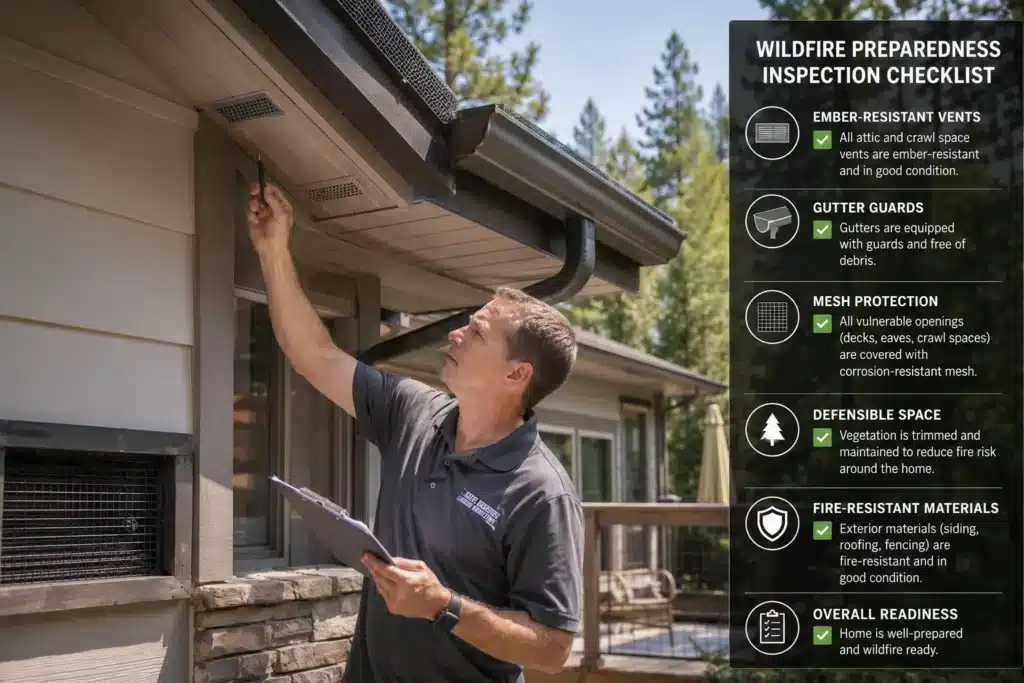
- Vents: EmberVent™ fire-resistant vents cover all vent locations: eaves, soffit, gable, dormer, and foundation, with ASTM-listed protection.
- Secondary gaps: EmberMesh™ protects deck skirting, fence gaps, and other openings that standard vents don’t cover.
- Gutters: FireStorm® Gutter Guards prevent debris accumulation in gutters, one of the most common ember ignition sites on the home exterior.
For the full picture on how vents, mesh, and gutter protection work together as a system, see Firestorm’s ultimate home wildfire protection guide.
Quick Checklist: Is Your Home Protected?
- Are your vents rated to ASTM E2886 or covered with 1/16″ noncombustible mesh?
- Are all vent locations covered—eaves, soffits, gables, dormers, and foundation?
- Are secondary gaps (under decks, fence connections, enclosed soffits) protected with ember-resistant mesh?
- Are your gutters protected from debris accumulation that can ignite from ember exposure?
- Is all installation precision-fit with no gaps that bypass the vent mesh?
If the answer to any of these is no or uncertain, you have an addressable vulnerability.
Conclusion
Embers are the primary wildfire threat to homes in WUI zones. Standard vents are the primary ember entry point. And standard vents are not designed to stop them.
Upgrading to fire-resistant vents, combined with EmberMesh™ for secondary gaps and FireStorm® Gutter Guards for debris-ignition protection, addresses the most predictable and common failure points in wildfire-related home loss. It’s not the complete picture of home hardening, but it’s the right place to start.

