

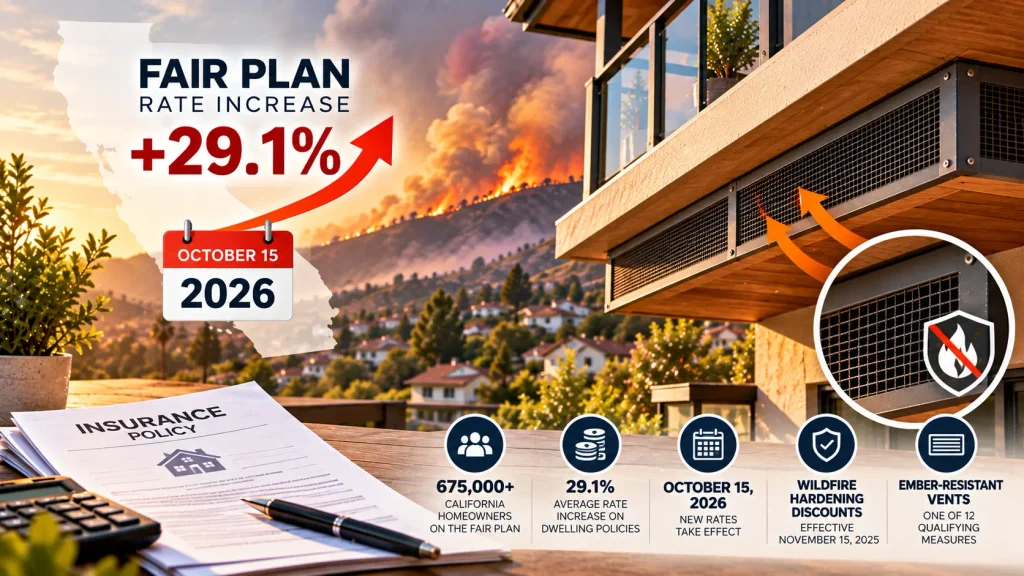
If you’re one of the more than 675,000 California homeowners covered by the FAIR Plan, mark October 15, 2026. That’s when the California Department of Insurance’s approved rate increase takes effect: an average of 29.1% on dwelling policies, the largest approved increase in the plan’s recent history. For homeowners in high wildfire-risk zones, the actual increase to the wildfire portion of their premium could be much higher. Some will see that portion double.
The increase is real, and for many households it’s going to hurt. But there’s a parallel development that doesn’t get nearly as much attention: the FAIR Plan’s wildfire hardening discount program, effective November 15, 2025, rewards policyholders who take documented steps to reduce their wildfire risk. Ember-resistant vents are one of the 12 qualifying measures. Here’s what the rate increase means, how the discount program works, and what homeowners should be doing before their next renewal.
California FAIR Plan Rates Are Rising October 15
The California Department of Insurance approved the FAIR Plan’s request for a 29.1% average rate increase on dwelling policies. The new rates apply to all new and renewal dwelling business with an effective date of October 15, 2026, or later.
That 29.1% is a statewide average, and the word “average” is doing significant work in that sentence. Individual increases are expected to range from roughly a 20% decrease to a 50% increase depending on the property. Lower-risk properties will likely see increases below the average. Higher-risk properties, particularly those in Very High Fire Hazard Severity Zones across foothill corridors and rural WUI communities, will likely land above it. Some will see the wildfire portion of their premium double.
The original FAIR Plan filing requested a 35.8% increase. CDI approved 29.1%. Either way, it’s the largest approved rate adjustment in recent history, topping the roughly 20% increase in 2019 and the approximately 16% increases in 2021 and 2023.
Why Homeowners Should Review Wildfire Protection Now
Rising FAIR Plan Costs
A 29.1% average increase on a policy that was already more expensive than standard market coverage is a significant financial hit. The FAIR Plan’s average statewide premium ran $3,000 to $3,200 per year before this increase, roughly double the cost of a standard admitted HO-3 policy. After October 15, households in higher-risk zones will be paying substantially more, and those costs are unlikely to trend back down in the near term.
Increasing Wildfire Exposure
The rate increase reflects underlying risk that isn’t going away. As of June 2026, the FAIR Plan’s total exposure stood at $768 billion—an 11% increase since September 2025 and a 250% increase since September 2022. The January 2025 Los Angeles wildfires alone generated claims that stress-tested the plan’s financial reserves. The largest component of the approved increase relates specifically to the wildfire portion of policyholders’ premiums, which is why properties with significant wildfire exposure are seeing disproportionate impacts.
Limited Private-Market Insurance Availability
The FAIR Plan was designed as a temporary safety net, not a long-term insurance market. But with major admitted carriers continuing to restrict or exit California’s highest-risk markets, more than 675,000 households are currently parked in it with limited alternatives. That said, the pace of new FAIR Plan enrollments appears to be slowing—new business in the first quarter of 2026 was down 25% compared to the same period the previous year—suggesting the private market may be gradually stabilizing in some areas. Homeowners who have completed documented wildfire mitigation improvements may want to check whether admitted carrier options have reopened for their property.
Can Home Hardening Lower a FAIR Plan Premium?
How the FAIR Plan Wildfire Hardening Discount Works
The FAIR Plan’s wildfire hardening discount program, effective November 15, 2025, allows Dwelling Fire policyholders to qualify for up to 12 individual discounts, all applied to the wildfire portion of the premium. Policyholders who qualify for all 12 measures can save up to 16.4% off that wildfire portion. Commercial policyholders can save up to 13.8%.
The discounts are organized into four categories: Immediate Surroundings (Zone 0 compliance, fencing, outbuilding placement, defensible space), Structure (roof, eaves, vents, windows, exterior walls), Property Level Completion (for qualifying across all measures in a category), and Community (Firewise USA or Fire Risk Reduction Community designation).
Two important caveats the spec brief correctly flags and that every homeowner should understand: First, the discounts apply to the wildfire portion of the premium, not the total premium. Second, discounts aren’t automatic. Each one requires documentation and verification, and they don’t appear on your policy unless you initiate the process with your broker.
Ember-resistant vents are one of the 12 qualifying structural measures. Installing them may contribute to discount eligibility. They do not, by themselves, guarantee a premium reduction; that depends on the full scope of qualifying improvements and how the wildfire portion of your specific premium is calculated.
Why Ember-Resistant Vents Matter for Home Wildfire Protection
Vents as Potential Ember Entry Points
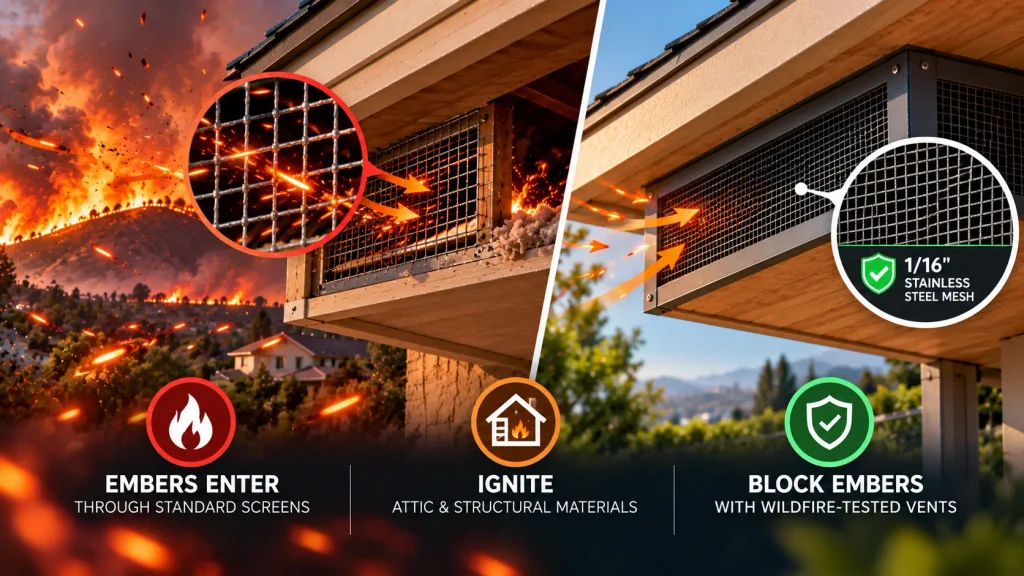
Wind-driven embers cause most home ignitions during wildfire events—not advancing flame fronts. Embers travel ahead of fires under sustained wind pressure, landing on and probing every opening they encounter. Attic vents, gable vents, soffit vents, eave vents, and foundation vents are all designed to move air. Under wildfire conditions, they move embers just as efficiently.
Once embers enter through a vent, they reach attic insulation, crawl space framing, and structural materials that ignite readily in an enclosed space — developing a fire that’s invisible from the exterior until it’s well-established. It’s one of the most common and preventable ignition pathways in post-fire structure assessments.
Standard Screens vs. Wildfire-Tested Vents
Standard insect screens and hardware cloth weren’t designed for wildfire exposure. Common 1/4″ and 1/8″ mesh openings allow many ember-sized fragments through freely. Fiberglass and plastic screening melts under radiant heat. None of these materials have been tested under ASTM E2886, the standard that evaluates vent resistance to ember entry and flame penetration under simulated wildfire conditions.
The FAIR Plan’s structural discount category specifically recognizes ember-resistant vents with 1/16″ mesh as a qualifying measure. That specification—1/16″ noncombustible metal mesh—differs significantly from standard hardware cloth, and that difference qualifies for the discount.
How Ember-Resistant Vents Improve Protection
EmberVent™ is Firestorm’s ember-resistant vent solution, tested and listed to ASTM E2886, E2768, and E84. It’s built around noncombustible stainless steel mesh at 1/16″ openings, engineered to block ember intrusion while maintaining the attic airflow your home requires. For properties pursuing the FAIR Plan structural discount, it’s the kind of documented, third-party-listed product that supports the verification process, not a generic hardware store screen with no testing behind it.
What Other Home Hardening Measures Matter?
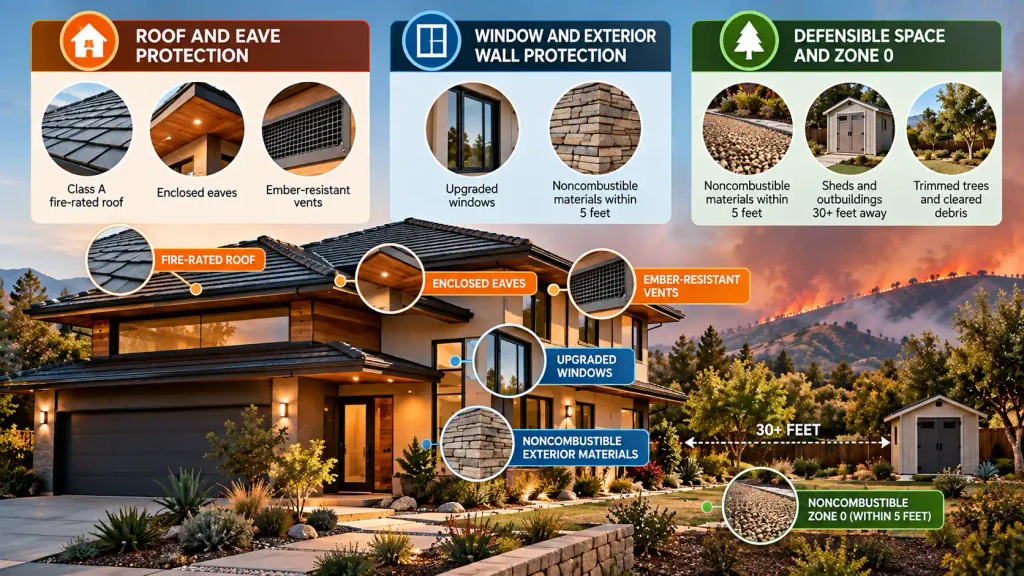
The FAIR Plan discount program rewards a comprehensive approach. Ember-resistant vents address one structural qualifying measure. The full discount stack covers:
Roof and Eave Protection
- Class A fire-rated roof covering (asphalt fiberglass composition, tile, concrete, slate, or metal)
- Enclosed eaves, with no accessible voids where embers can accumulate
- Ember-resistant vents at all exterior vent locations
Window and Exterior Wall Protection
- Upgraded windows (multi-pane glazing reduces radiant heat transmission)
- Noncombustible materials used in improvements within five feet of the dwelling
Defensible Space and Zone 0
- Noncombustible materials only within five feet of the structure; no combustible mulch, vegetation, or stored materials
- Combustible sheds and outbuildings at least 30 feet from the dwelling
- Trees trimmed, brush and debris cleared, and property in compliance with California Public Resources Code Section 4291 defensible space requirements
These measures work together as part of a broader wildfire hardening strategy. The discount program rewards comprehensive mitigation. The Property Level Completion discount is available only to policyholders who qualify across all measures in a category, which means partial compliance in any category leaves money on the table.
How Homeowners Can Prepare Before October 15
Check Your FAIR Plan Renewal Date
The new rates apply to policies with an effective date of October 15, 2026, or later. If your policy renews before October 15, your current term keeps existing pricing. If it renews on or after that date, the new rates apply. Know your renewal date before doing anything else; it tells you how much time you have.
Review Your Current Wildfire Discounts
Contact your broker and confirm which of the 12 qualifying hardening measures are already documented on your policy. Many policyholders who have completed improvements are not receiving the associated discounts simply because they haven’t submitted documentation. This is the fastest potential premium correction available, no new work required, just paperwork.
Inspect Existing Vents
Walk the exterior of the structure and look at every vent location: attic, gable, soffit, eave, and foundation. Note the mesh material, the opening size, and whether there are gaps at the frame perimeter or visible corrosion or damage. Standard hardware cloth at 1/4″ or 1/8″ openings does not meet the 1/16″ ember-resistant standard. Fiberglass screening fails under heat. What you find tells you whether vent upgrades belong on your improvement list.
Identify Other Home-Hardening Gaps
Work through the full building, including roof, eaves, windows, gutters, deck perimeter, foundation vents, and Zone 0 clearance. Firestorm’s wildfire home hardening checklist provides a structured walkthrough of every location and helps you identify which improvements would contribute to discount eligibility.
Complete Qualifying Improvements
Prioritize based on your property’s specific vulnerabilities and the discount categories you’re closest to qualifying for. Vent upgrades, Zone 0 debris clearance, and defensible space compliance tend to be the most accessible entry points. Roof replacement and window upgrades are higher-cost improvements with longer payback periods — but for properties with significant wildfire exposure, the structural discount category may justify the investment.
Keep Documentation
Every qualifying improvement needs to be documented to apply for the discount. Save product invoices, installation photographs, manufacturer spec sheets showing ASTM listing numbers, and any contractor receipts. The FAIR Plan discount isn’t retroactive to improvements you can’t verify—documentation is the difference between a discount that applies and one that doesn’t.
Contact Your Broker
Confirm your current discount eligibility, what documentation each qualifying measure requires, and whether you can apply any improvements you’ve already completed at your next renewal. Your broker can also advise on whether the private market has reopened for your property a conversation worth having given how quickly the landscape has been changing.

Can Ember-Resistant Vents Alone Lower Your Premium?
Ember-resistant vents are one of 12 qualifying structural protection measures in the FAIR Plan’s wildfire hardening discount program. Installing them may help you qualify for a structural discount, but the program is cumulative. A single upgrade to a single qualifying measure doesn’t automatically produce a premium reduction; the discount stack rewards comprehensive mitigation across all four categories.
That said, vent upgrades are among the more accessible and cost-effective improvements available. They address a documented ignition pathway, contribute to the structural discount category, and are the kind of third-party-tested, documented improvement the verification process is designed to reward. Whether they produce a meaningful premium reduction depends on your property’s specific risk profile, how much of your premium is attributable to wildfire exposure, and what other qualifying improvements are already in place. Confirm your individual eligibility with your broker because they have access to your specific policy details and can tell you exactly what an additional qualifying measure would mean for your premium.
Build a Complete Wildfire Home Protection Strategy
Protect the Entire Building
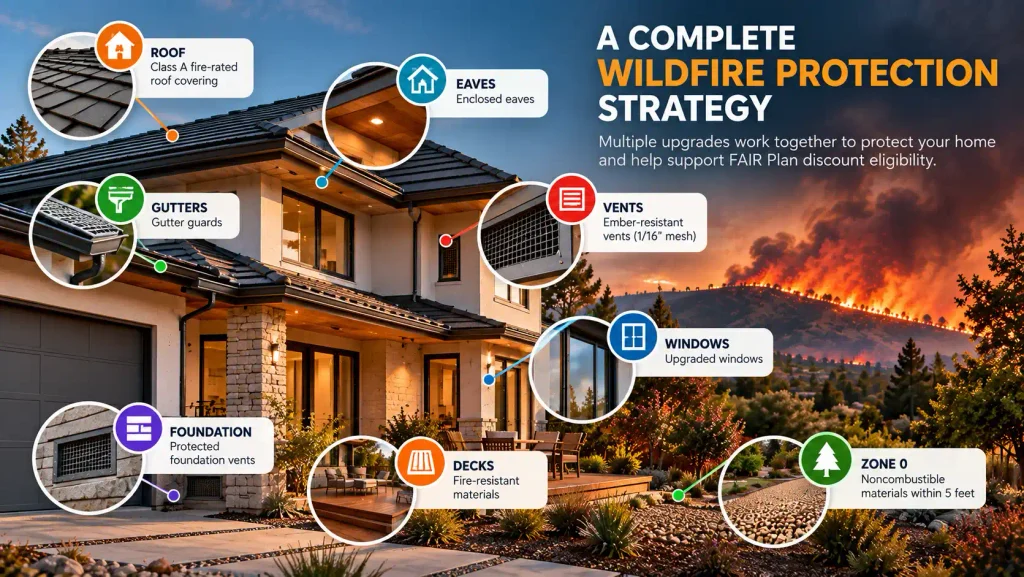
The FAIR Plan discount program is structured around a whole-home approach for the same reason the IBHS Wildfire Prepared Home designation is: ember attacks probe the entire structure simultaneously. A home with protected vents and debris-filled gutters still has an ignition pathway at the roofline. A home with a Class A roof and unprotected foundation vents still has an ignition pathway at ground level.
The complete protection sequence—roof, vents, eaves, windows, gutter guards, decks, foundation, Zone 0—addresses each category of vulnerability in the order that matters. EmberVent™ handles the vent openings. EmberMesh™ closes secondary gaps that vents don’t cover. Gutter guards eliminate the roofline fuel accumulation that turns an ember landing into a structural ignition.
Each component contributes to the whole. That’s also how the FAIR Plan discount program works—the maximum discount comes from qualifying across all categories, not from optimizing any single one.
Protect Your Home Before the Next FAIR Plan Renewal
The October 15 rate increase is happening regardless of what any individual homeowner does. For properties with significant wildfire exposure, the impact will be substantial. The question isn’t whether premiums are going up, it’s whether documented mitigation improvements can offset some of that increase and reduce real wildfire risk at the same time.
Ember-resistant vents address one of the most consistent and preventable ember entry points on a home. They’re a qualifying structural measure in the FAIR Plan’s discount program. They’re a concrete, documentable improvement that supports the verification process. And in a rate environment where every qualifying measure counts, they’re worth evaluating as part of a comprehensive approach rather than in isolation.
Review your current vent protection before your next renewal. Identify the gaps. Document the improvements you complete, and confirm your eligibility with your broker because they’re your fastest path to making sure any discount you’ve earned is actually showing up on your policy.
If you’re ready to evaluate your home’s ember entry points, start with Firestorm’s EmberVent™ ember-resistant vents and work outward from there.
________
This article is for educational purposes only and does not constitute insurance advice. FAIR Plan discount eligibility, rates, and qualifying criteria are subject to change. Confirm current program details and your individual discount eligibility with a licensed California insurance broker.

